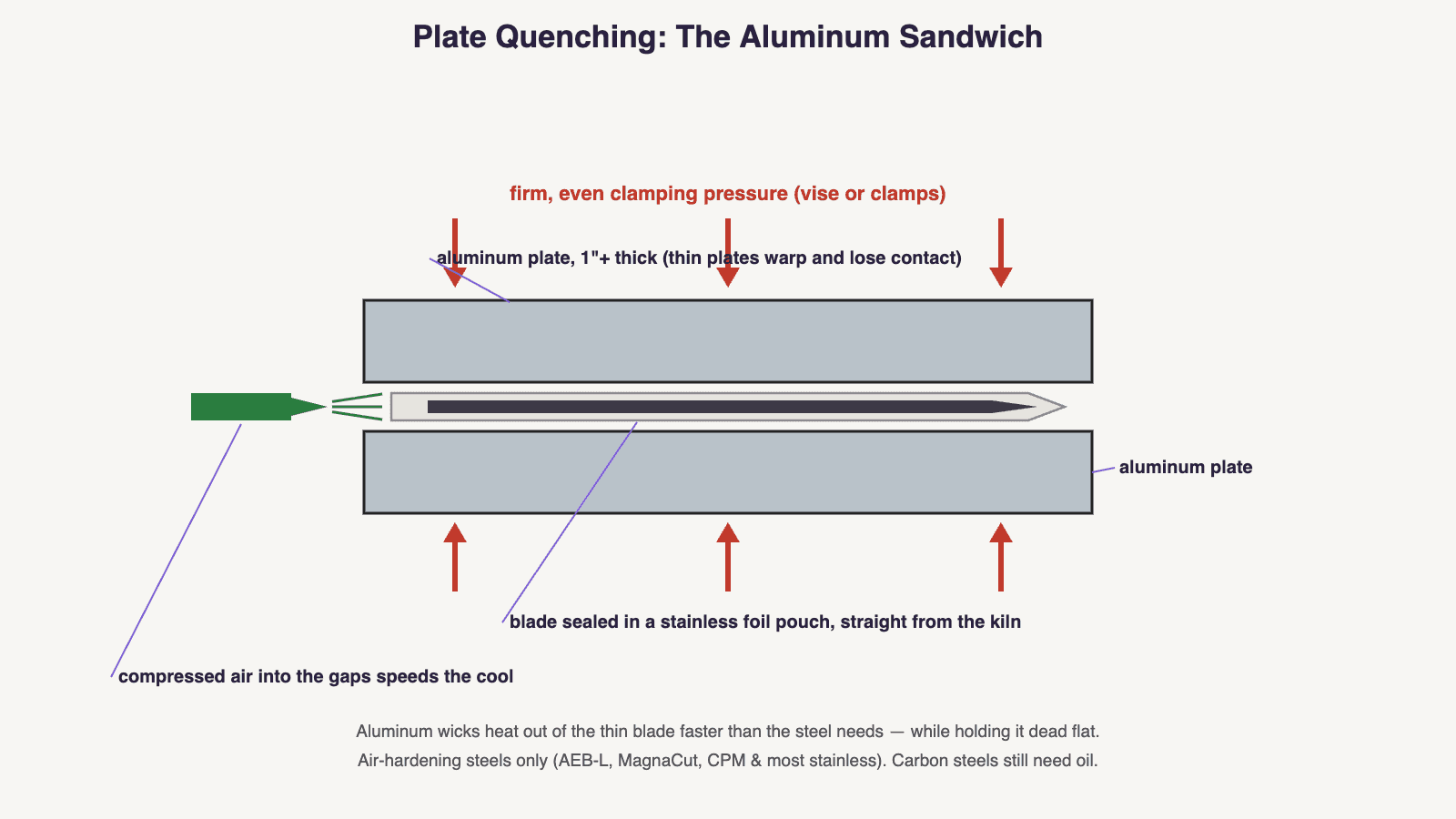
Diagram: plate quenching a knife — a blade in a stainless foil pouch clamped between one-inch-plus aluminum plates with firm even pressure and compressed air blown into the gaps, for air-hardening steels

Heat Treat

Plate Quenching Explained: Why Stainless Blades Get Squeezed, Not Dunked

Quench plates explained: why aluminum plates harden AEB-L, MagnaCut and CPM stainless dead flat - plate thickness, clamping, air assist, cryo.

3 min readWritten by Rich LinvilleFree to read

Somewhere in every stainless steel’s heat-treat sheet is a phrase that confuses first-time kiln owners: “plate quench.” No oil, no dramatic hiss — the blade comes out of the kiln in its foil pouch and gets squeezed between two thick aluminum plates until it’s cool. That gentle-sounding process is a genuine quench, it’s the standard for the modern stainless and PM steels, and it comes with the single best side effect in heat treating: blades that come out dead flat.
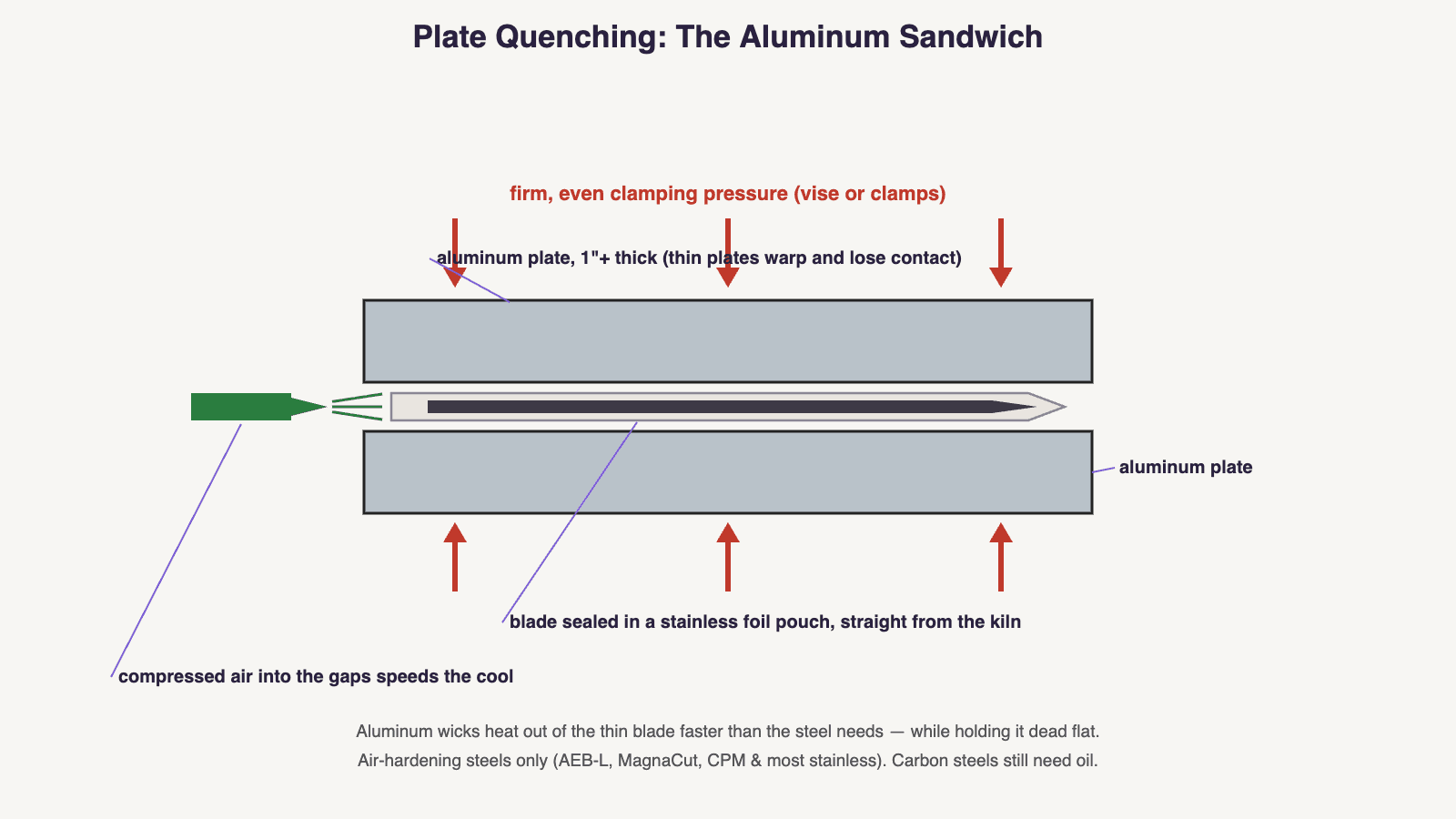
Plate Quenching: The Aluminum Sandwich

  • firm, even clamping pressure (vise or clamps)
  • aluminum plate, 1"+ thick (thin plates warp and lose contact)
  • aluminum plate
  • blade sealed in a stainless foil pouch, straight from the kiln
  • compressed air into the gaps speeds the cool

Aluminum wicks heat out of the thin blade faster than the steel needs — while holding it dead flat.

Air-hardening steels only (AEB-L, MagnaCut, CPM & most stainless). Carbon steels still need oil.

The whole technique in one picture: foil pouch, thick aluminum, even pressure, air assist.

Why Plates Work (and for Which Steels)

Whether a quench “counts” depends on one thing: cooling the steel faster than its transformation window demands (the metallurgy). Simple carbon steels like 1084 give you about a second — only liquid is fast enough, which is what the quench oil guide covers. But high-alloy air-hardening steels — AEB-L, MagnaCut, the CPM family, 154CM, Elmax, Nitro-V — have windows so generous they’ll harden in still air. Aluminum, one of the best heat conductors you can cheaply buy in slabs, pulls heat out of a thin blade far faster than these steels need — with a bonus no liquid can offer: the blade hardens while physically held flat. Thin kitchen-knife blanks that would potato-chip in a liquid quench come out of plates straight.
The Process, Start to Finish

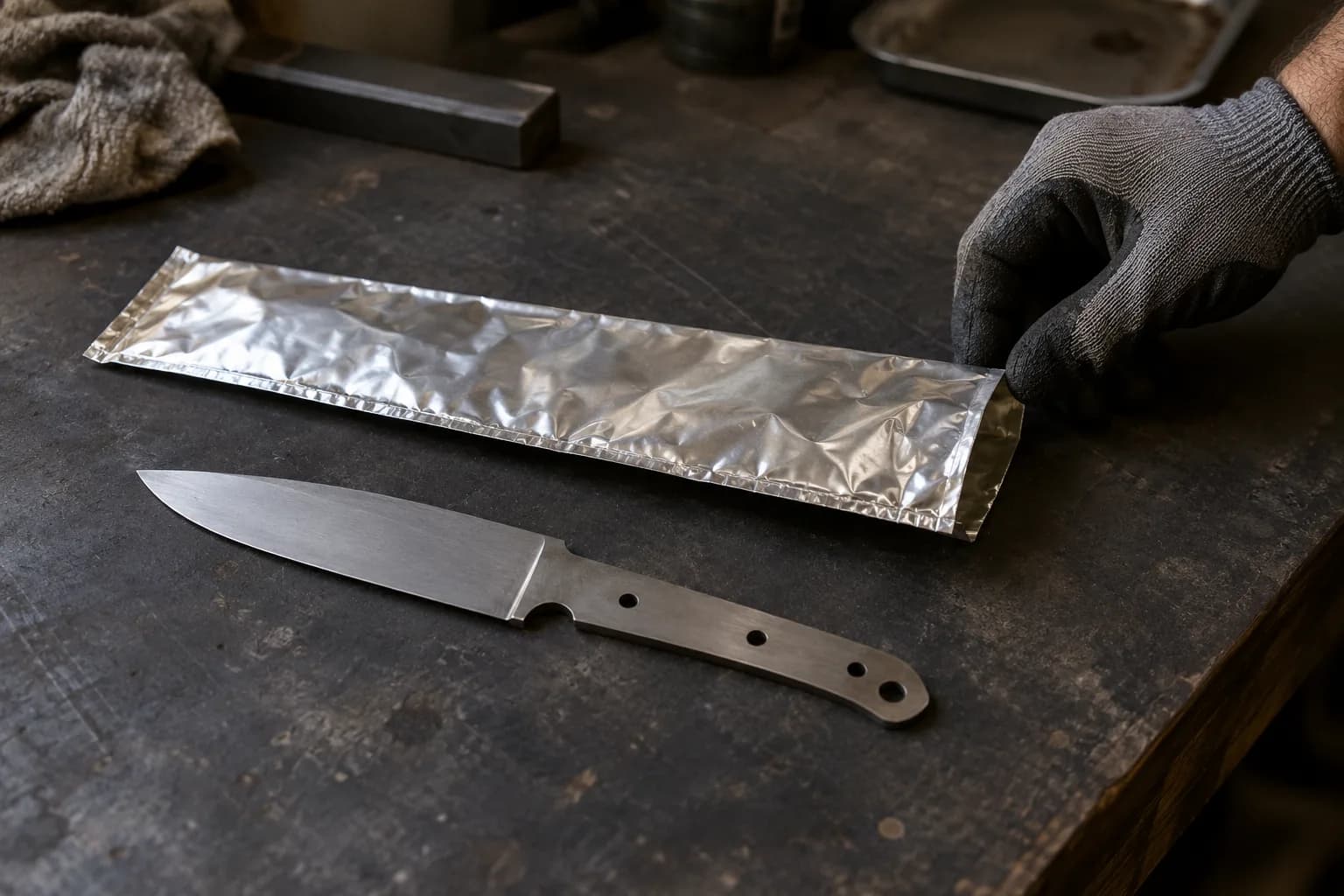
  1. Foil pouch first. Air-hardening steels need long, high kiln soaks, and unprotected steel would scale and decarburize badly. The blade goes into a sealed stainless tool-wrap pouch (double-crimped edges) before the kiln, and stays in it through the quench.
    Bare knife blank on a dark bench beside a crimped foil pouch, a gloved hand holding the pouch corner
  2. Soak per the steel’s data sheet — for MagnaCut, the CPM family and the other high-carbide stainless this is kiln territory (see the oven buyer’s guide; no kiln? These steels are exactly what heat-treat services are for). AEB-L, 14C28N and Nitro-V also harden from a forge: about 1925 to 1975°F with a short soak, then straight into the plates, a point or two softer than a kiln gets them.
  3. From kiln to plates in seconds. Have the plates open and waiting next to the kiln, grab the pouch with pliers, lay it flat, close the sandwich. Speed here matters — the steel is cooling in air from the moment the door opens.
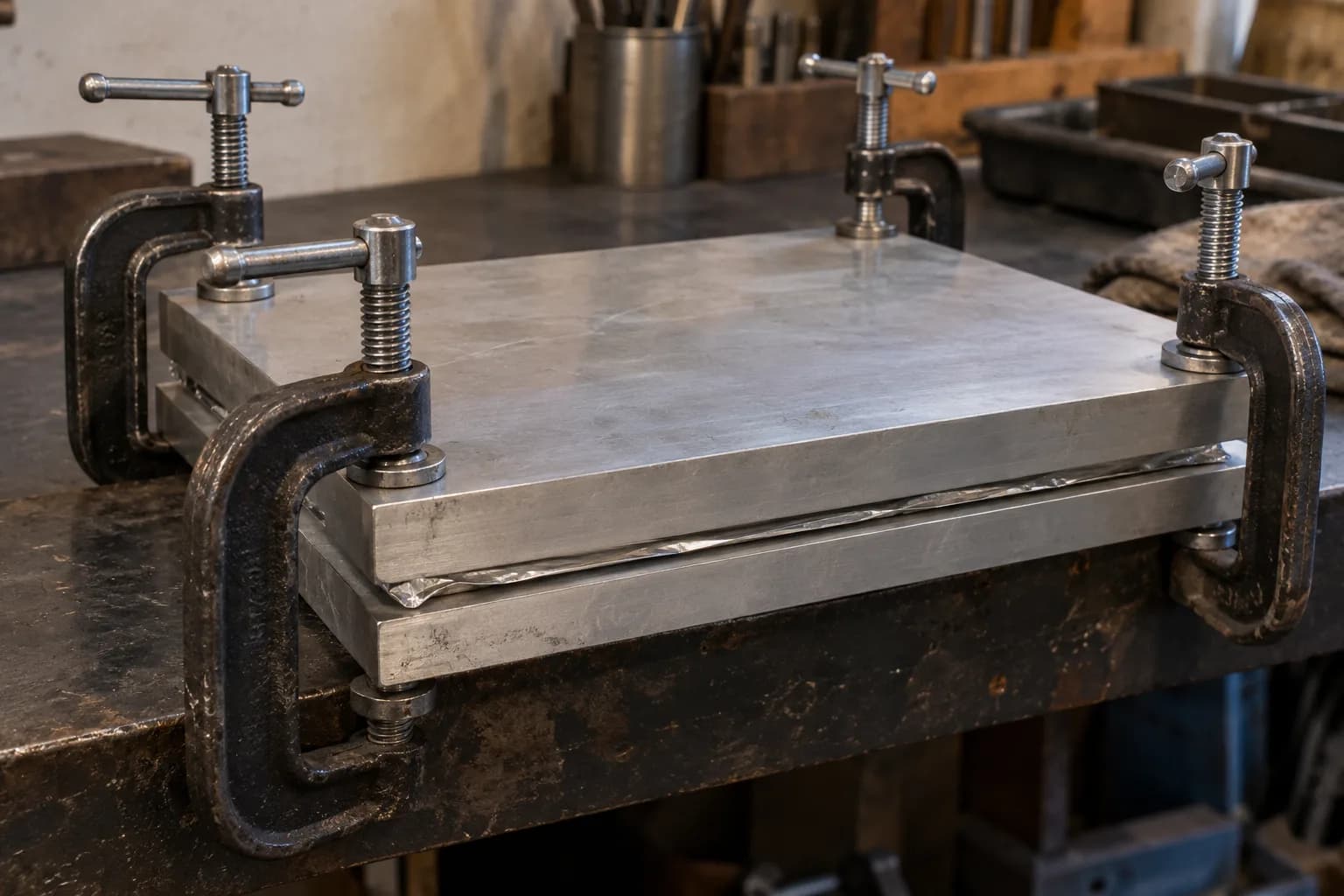
  4. Firm, even pressure. Clamp the sandwich — a purpose-built quench vise gives one-motion even pressure (this is what the Torus 4×14 Quench Master is built for), or use C-clamps at the corners. Even contact is the whole game: gaps cool slower and unevenly, and uneven cooling is where warps and soft spots come from.
    Two thick aluminum slabs with a foil pouch edge between them, held by four C-clamps at the corners on a steel bench
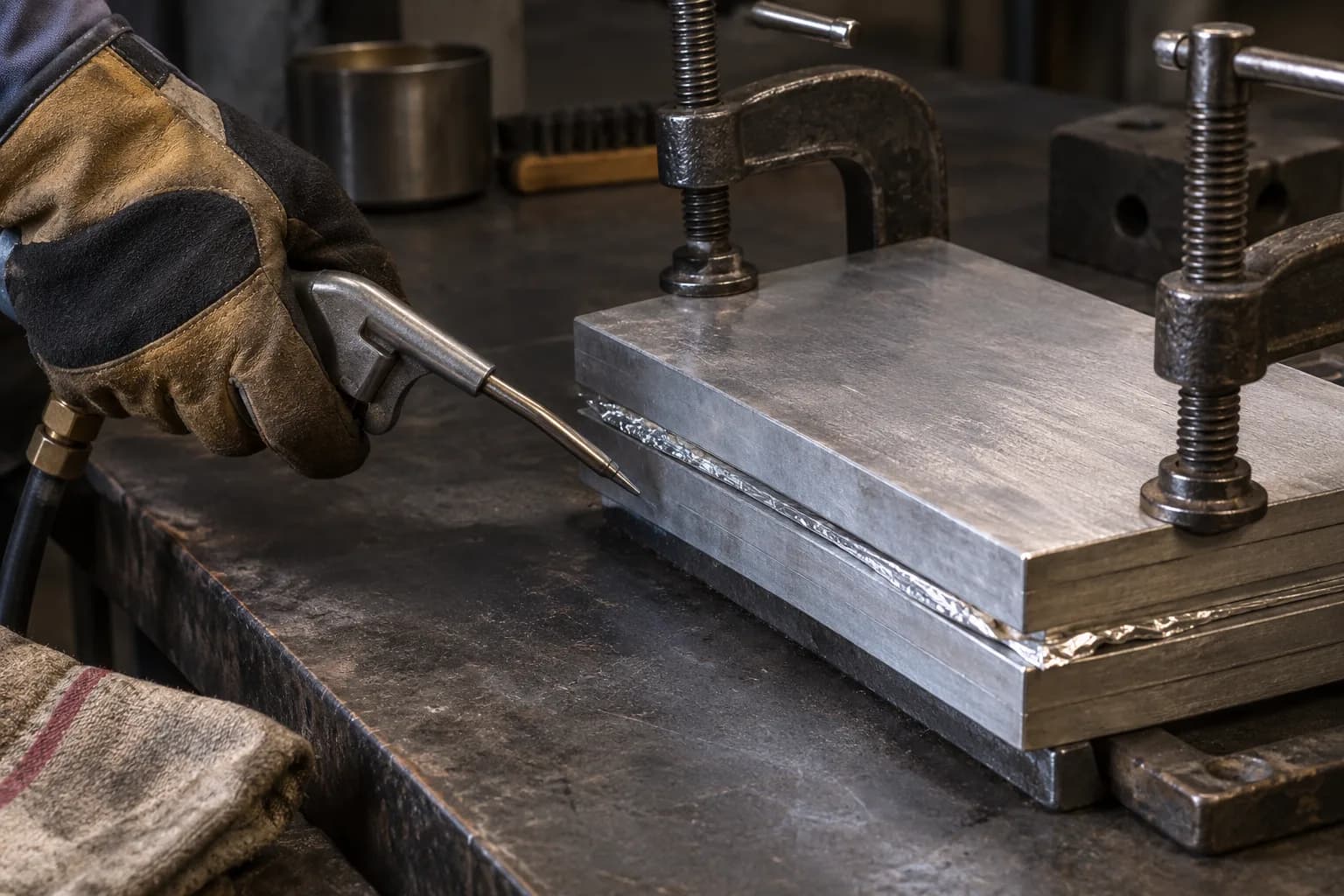
  5. Compressed air into the gaps. The standard accelerator: blow shop air along the pouch’s edges and any gap between the plates during the cool. It audibly speeds things up and helps the thin edge and thick spine cool together.
    Gloved hand aiming a compressed-air nozzle along the foil seam of two clamped aluminum quench plates on a bench
  6. Hold until hand-warm, then keep moving. A couple of minutes in the plates typically does it. Most of these steels then want immediate cold treatment — freezer at minimum, dry ice or liquid nitrogen for full performance (why cryo matters) — and clamping the blade flat for that cold trip prevents thermal-shock warp. Then temper per spec, twice.

The Plates Themselves

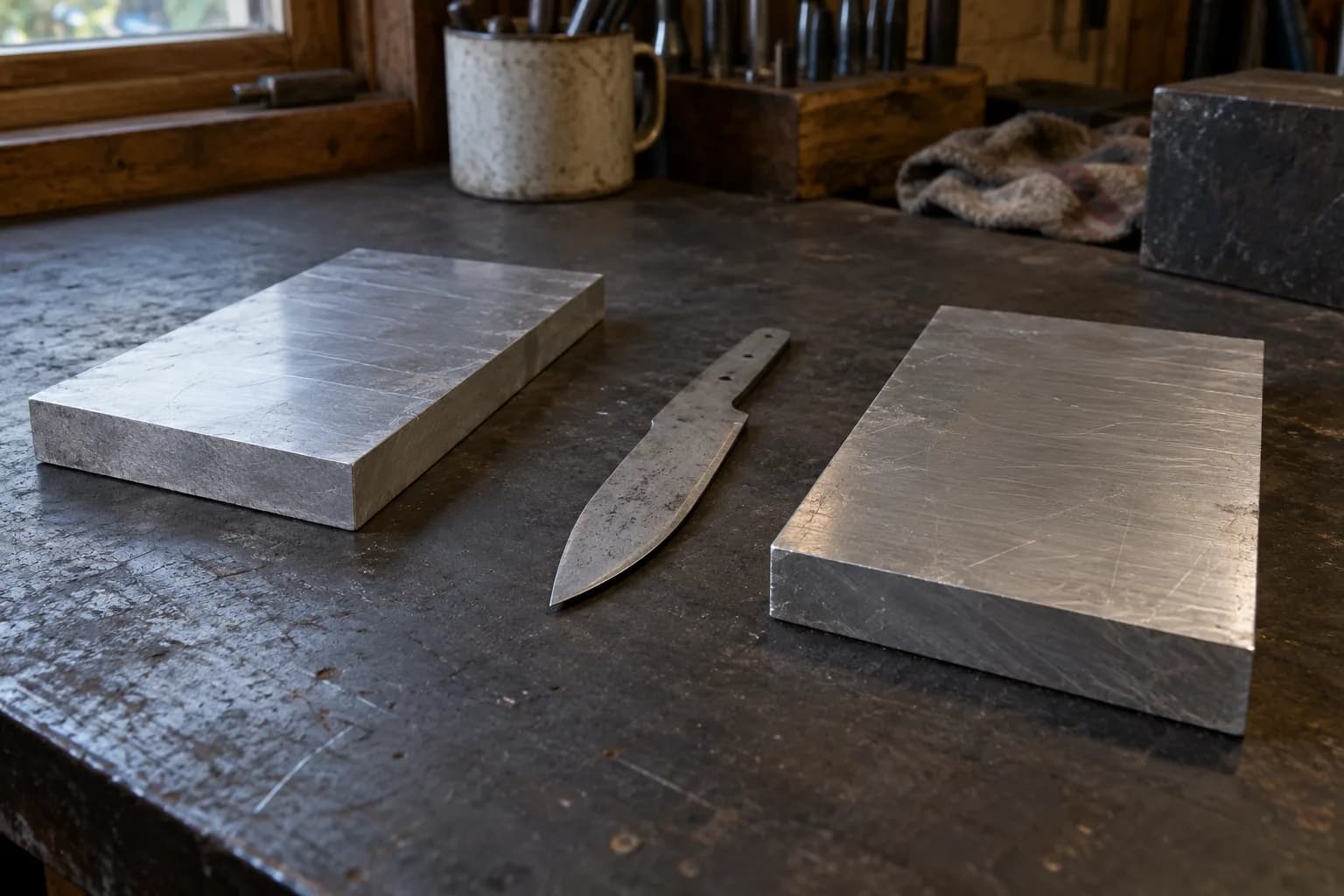
  • Aluminum, at least 1″ thick. The community-consensus minimum — thinner plates heat-warp during the quench, lose flat contact, and defeat the purpose. Thicker is better; mass is the coolant.
    Two thick flat aluminum slabs on a dark bench with a smaller knife blank lying between them, window light behind
  • Bigger than the blade, with clean, flat faces. Dings and scale print through foil into a hot blade.
  • DIY or bought: two offcuts of 1″+ aluminum bar from a metal supplier plus C-clamps genuinely work. Purpose-built systems — like the Torus XL 4×14 Quench Vise, for blades up to about 14 inches — buy you machined-flat faces and one-motion clamping, which matters most in that kiln-to-plates sprint.

Honest Limits

Plate quenching is not a universal upgrade — it’s the correct quench for air-hardening steels and wrong for shallow-hardening carbon steels (1084, 1095, W2, 5160 still need oil — plates simply can’t pull heat from inside a blade fast enough for a one-second window). It’s also a kiln-side technique: precise soaks are what make these steels perform, so plates pair with a kiln or a pro service, not a torch. And if a blade still comes out with a bow: light pressure straightening during the temper cycle is standard practice — see the warping entry.

Sources

Keep reading

Read these related guides

Three more from the same bench.

Same bench

Put the reference to work

I machine the parts, hand-assemble, track and test Torus grinders in Sterling, Illinois. Most orders ship in seven to ten business days from time of order.
  • Classic aluminum 2x72 grinder, side view with flat-platen tool arm and yellow Safety Rules label, on black with a purple glow

    Torus 2×72 Classic Aluminum Belt Grinder

    Prior-design aluminum chassis, 90-degree tilt and 1.5-inch tooling arms.
    Starts at$995View

One-man shop

Still stuck? Ask me.

I answer my own email. Tell me the steel, the machine and what it is doing, and I will tell you what I would try next.