
Beginner Guides
Basic Knife Anatomy & Terminology
Knifemaking has its own vocabulary, and a lot of guides (including this one) assume you already know it. Here’s every term you’ll actually run into…
Heat Treat
A complete, stage-by-stage guide to heat treating knife steel: normalizing, austenitizing, quenching and tempering, with typical ranges by steel family.
3 min readWritten by Rich LinvilleFree to read
Heat treating is what turns a piece of flat bar stock into a functional knife blade. Done correctly, it transforms the steel’s internal crystal structure so the edge can be hardened, sharpened, and hold up to real use. Done poorly, even a premium steel like MagnaCut or CPM 3V will perform worse than a cheap production blade. This guide walks through the full process, with typical ranges by steel family and links to detailed guides on each stage.
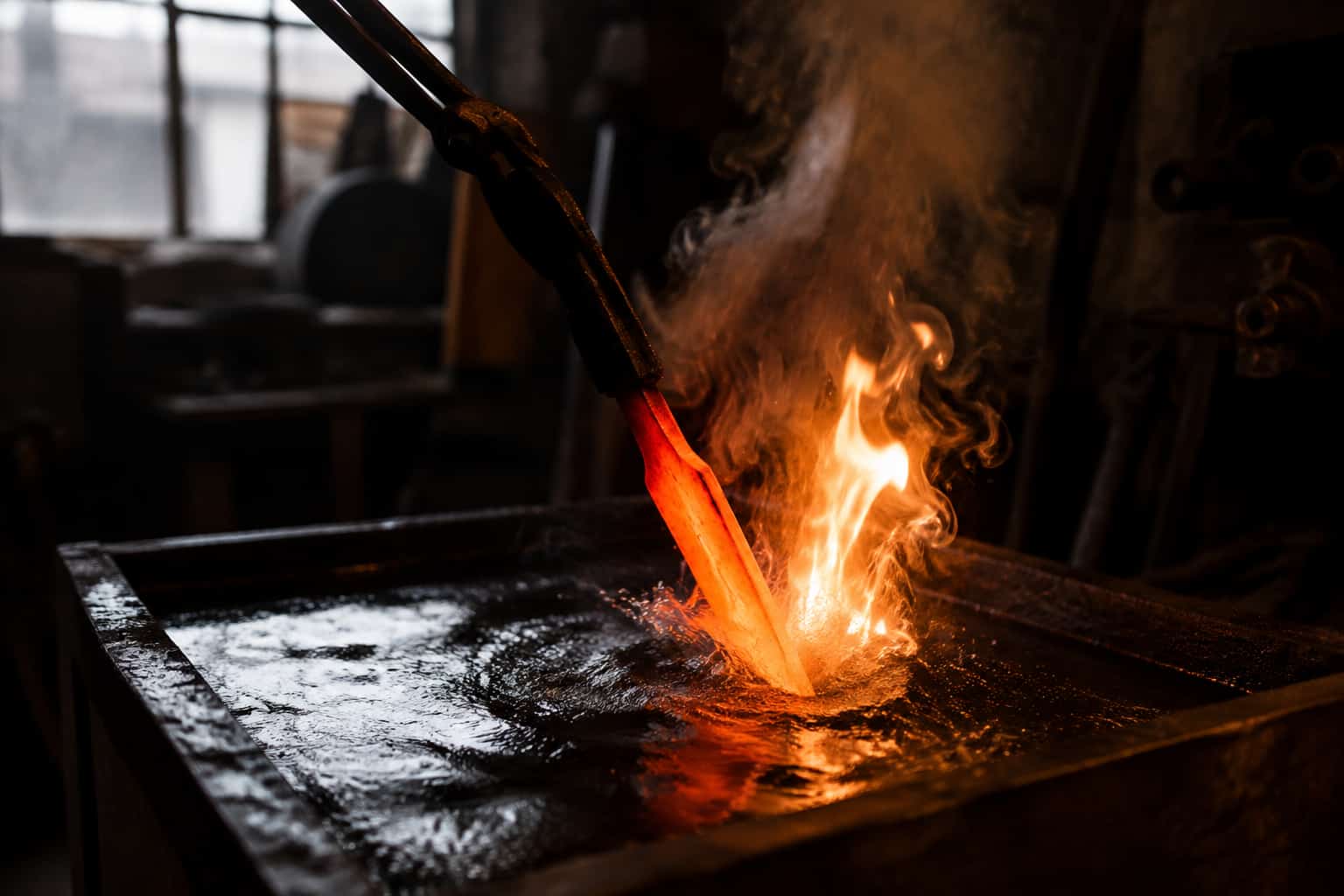
After forging, or before heat treating stock-removal blanks that have seen heavy machining, normalizing relieves internal stress and refines the grain structure. It generally means heating the blade above its critical temperature, holding briefly, then air cooling, often repeated two or three times at slightly decreasing temperatures. Air-hardening and stainless powder-metallurgy steels are usually not normalized by hand in a home shop, since their published heat-treat specs typically skip this step.
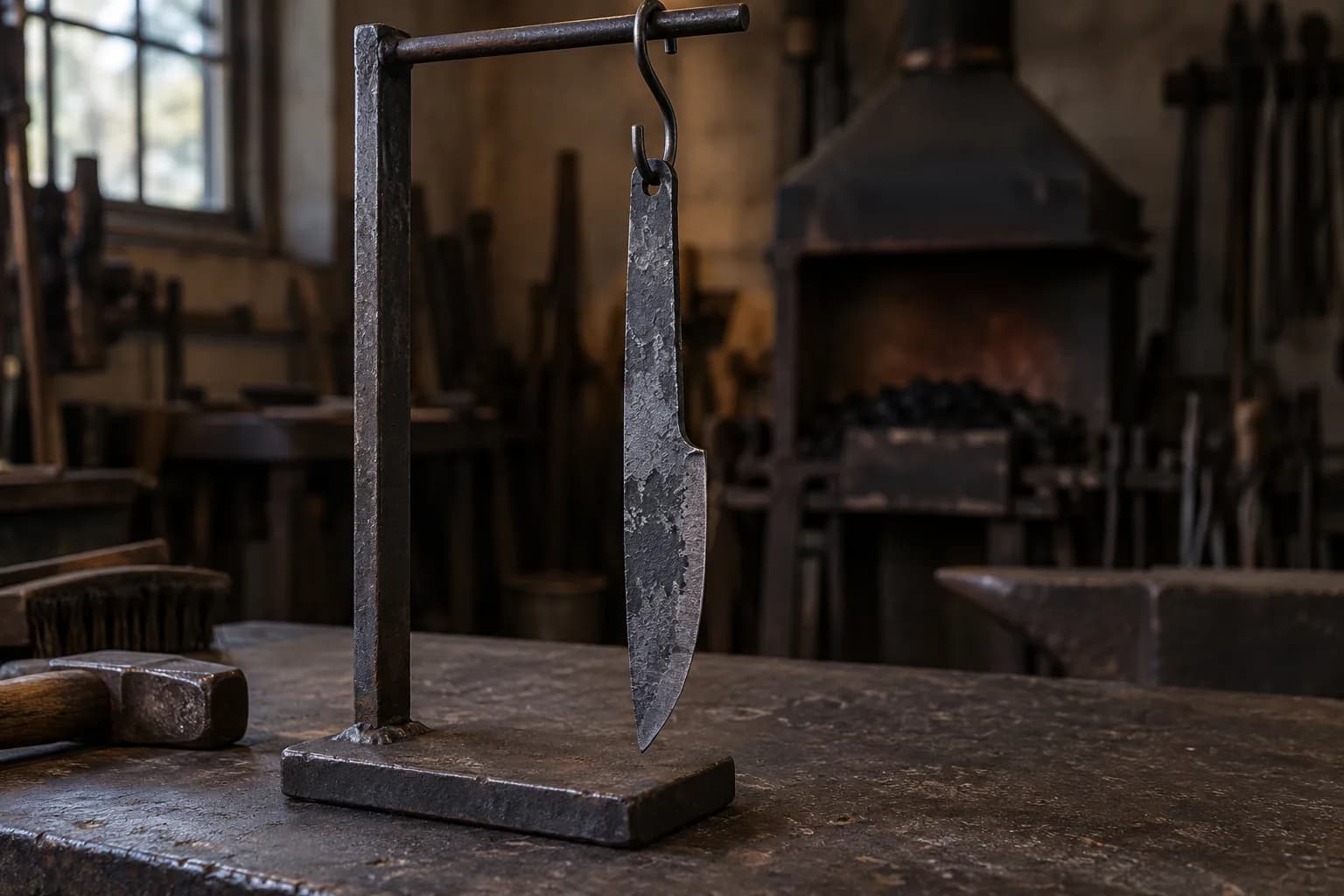
This is the step that actually hardens the steel. The blade is heated to its specific austenitizing temperature, which varies enormously by alloy, from roughly 1450 F for simple carbon steels like 1084 up to 2050-2100 F for high-alloy stainless steels like MagnaCut or M390, and held long enough for carbon and alloying elements to dissolve into the crystal structure. Soak times range from a couple of minutes for thin simple-carbon blades to twenty or more minutes for thick, high-alloy stainless blades. Always use the steel’s specific published spec here; guessing at temperature is one of the most common and costly mistakes in home heat treating.
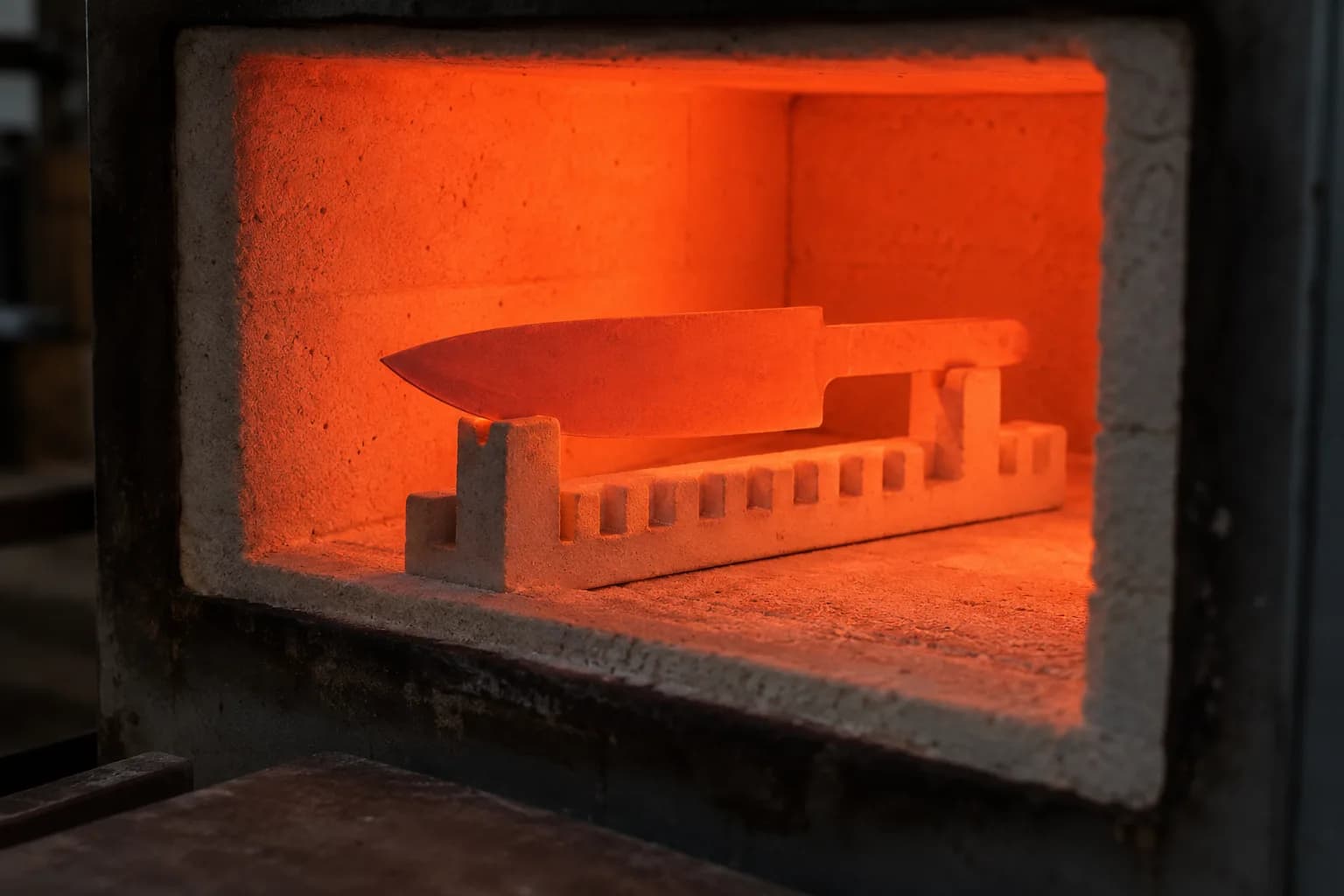
Immediately after austenitizing, the blade is rapidly cooled to lock the hardened crystal structure (martensite) in place. The quench medium depends entirely on the steel: simple carbon steels like 1084 and 1095 are typically quenched in fast oil; air-hardening steels like CPM 3V and D2 can be quenched in still air or a light oil; stainless PM steels like MagnaCut are quenched between pre-heated steel plates (a quench vise that clamps the plates makes this much easier to control) or in oil to control warping. Quenching too slowly for the steel and medium combination is one of the most common causes of a blade coming out of heat treat too soft.
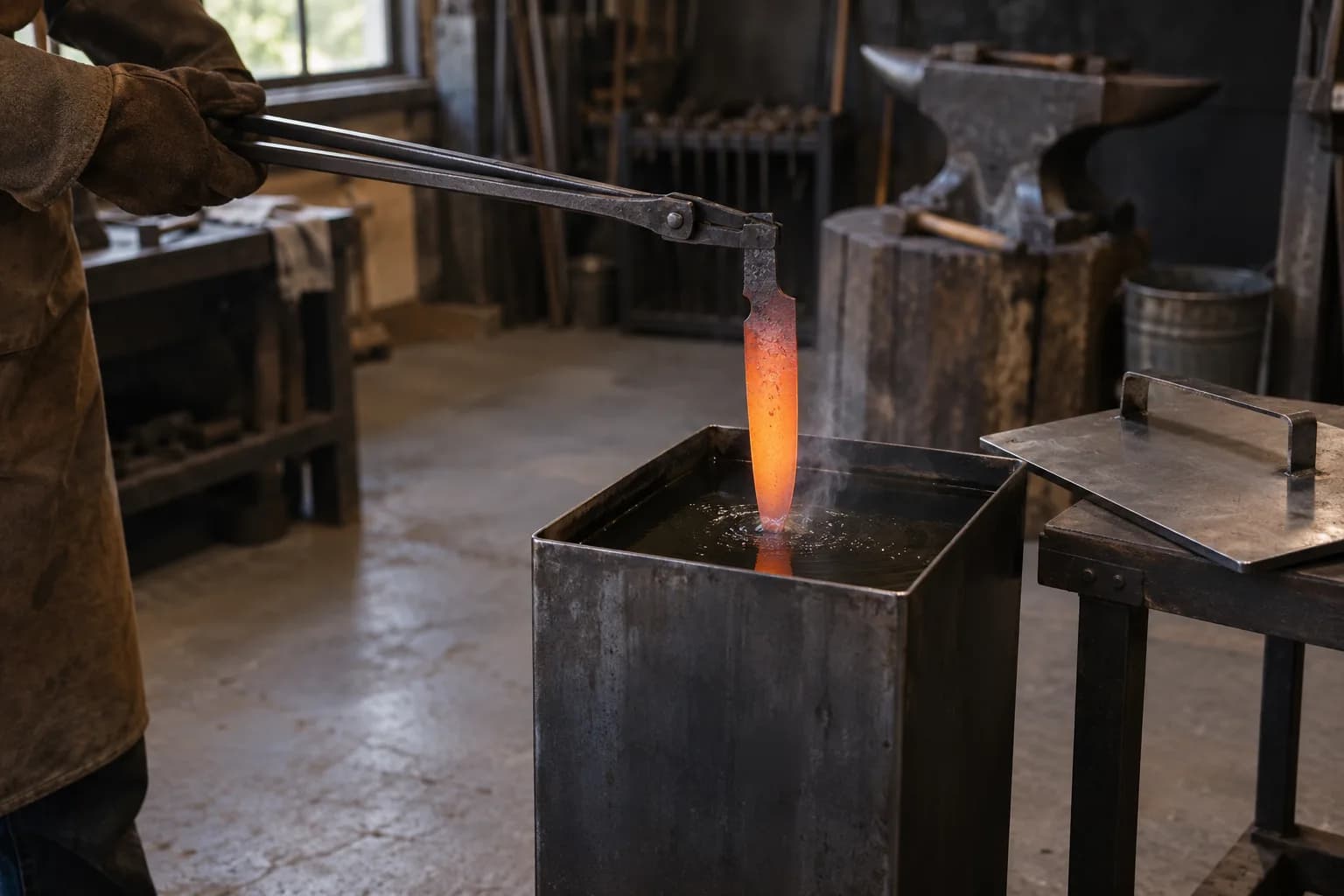
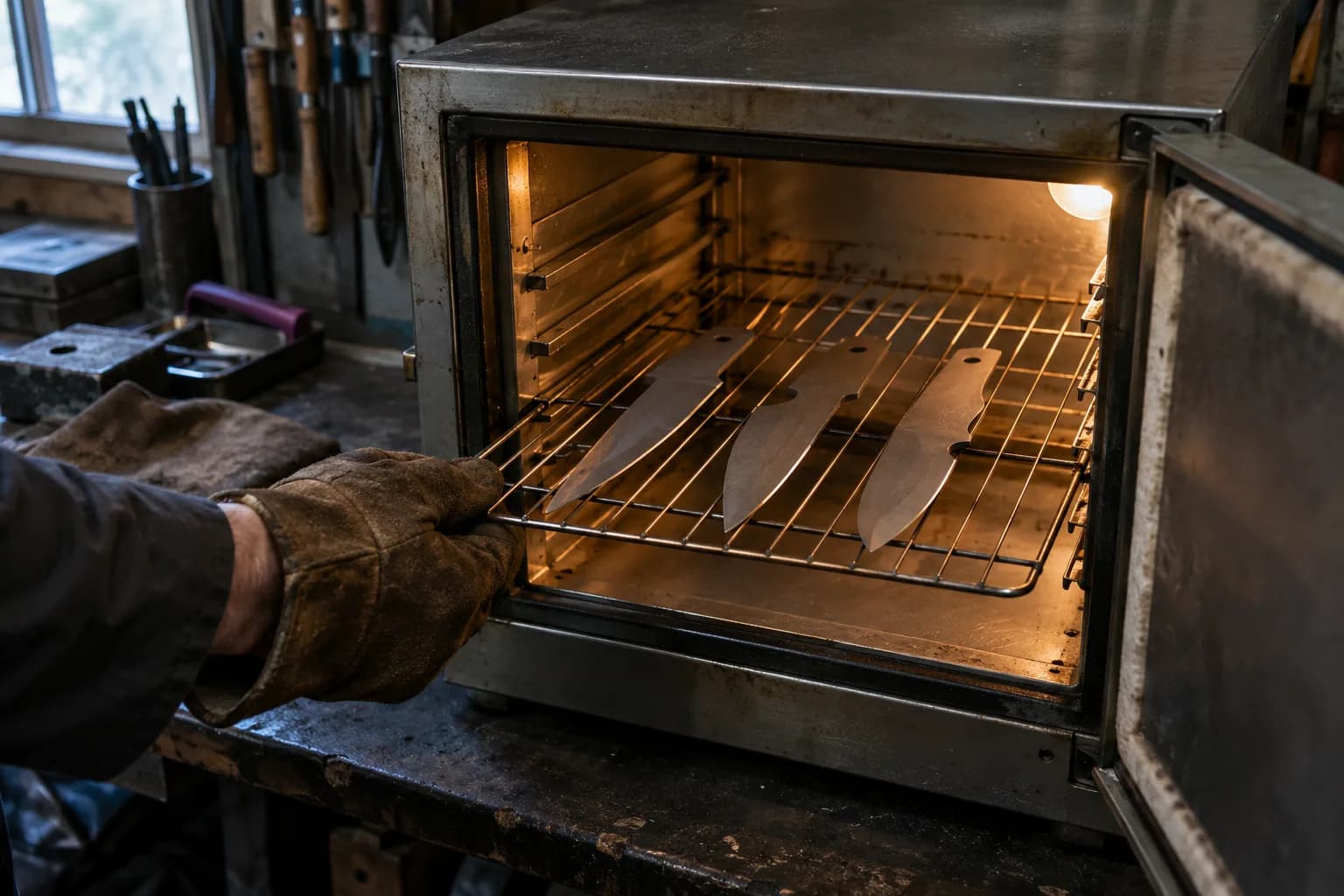
A freshly quenched blade is extremely hard but dangerously brittle. Tempering trades a small amount of hardness for a large gain in toughness by reheating the blade to a much lower temperature, commonly 300-450 F depending on the steel and desired final hardness, for one to two hours, letting it cool, then repeating the cycle. Double tempering is standard practice for most modern steels: it relieves the stress the first cycle creates and gives any retained austenite a chance to transform. Skipping temper, or only doing it once, is a common way to end up with a blade that chips or cracks in normal use.
| Steel Family | Austenitize | Quench | Temper |
|---|---|---|---|
| Simple carbon (1084, 1095, W2) | ~1475-1500 F | Fast oil | 350-450 F, 2x1hr |
| Low-alloy (5160, 80CrV2, 52100) | ~1500-1550 F | Oil | 375-425 F, 2x1hr |
| Air-hardening tool steel (CPM 3V, D2) | ~1850-1950 F | Air or light oil | 400-1000 F by target hardness, 2x2hr |
| Stainless PM (MagnaCut, S35VN, M390) | ~1950-2100 F | Plate or oil quench | 300-400 F, 2x2hr |
These are general starting points, not substitutes for the steel manufacturer’s published specification.
You can for simple, shallow-hardening steels like 1084 or W2 if you develop good judgment for color and use a magnet to check for the loss of magnetism near critical temperature, but it is far less precise than an oven and unsuitable for high-alloy steels and high-carbide stainless that need tightly controlled soak temperatures. Low-carbide stainless such as AEB-L and 14C28N wants about 1925 to 1975°F with a short soak: a forge can do that, a hand torch struggles to hold it evenly.
A programmable electric heat-treat oven gives far more consistent, repeatable results than judging color at the forge, especially for anything beyond simple carbon steel. Most modern PM stainless and air-hardening tool steels effectively require one.
Usually uneven heating, an asymmetrical blade profile, or a quench that is too aggressive for the steel and geometry.
Next in the Heat Treat Library: normalizing and thermal cycling, choosing a quench oil, plate quenching for stainless, the temper color chart and what to do when a blade warps. For steel-specific heat-treat specs, browse the Knife Steel Database.
Keep reading
Three more from the same bench.
Knifemaking has its own vocabulary, and a lot of guides (including this one) assume you already know it. Here’s every term you’ll actually run into…
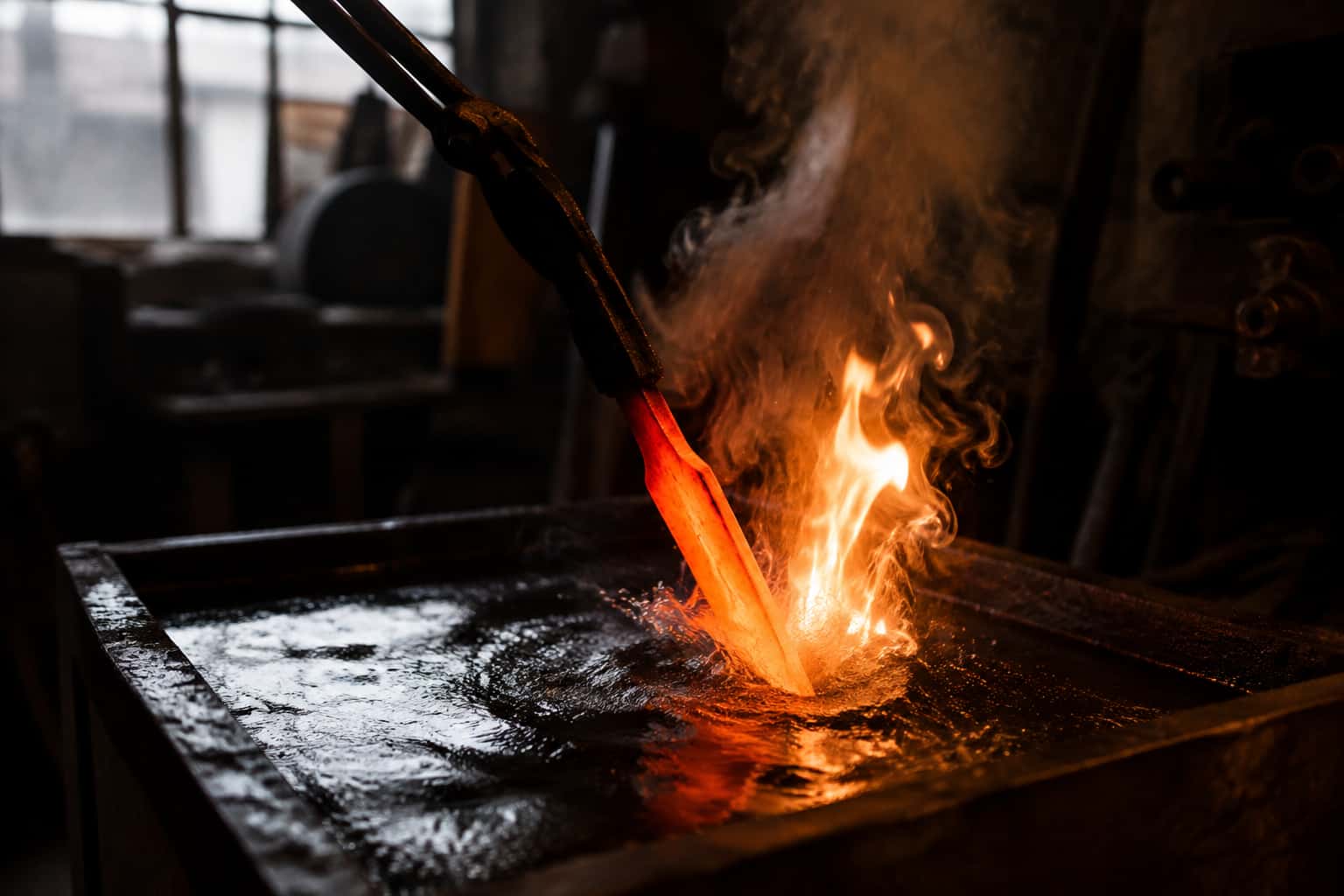
Heat treating introduces hazards grinding doesn’t: open flame, hot oil, and steel well over 1,000°F. None of it is complicated to do safely, but it does…

The Heat Treating Guide covers the practical steps: normalize, austenitize, quench, temper. This guide covers what’s actually happening inside the steel…
Same bench
I machine the parts, hand-assemble, track and test Torus grinders in Sterling, Illinois. Most orders ship in seven to ten business days from time of order.

Current dual-axis platform with a fiber-laser-cut 6061 chassis and single-knob tracking.

Current dual-axis platform with a steel chassis, more mass and less vibration.

Prior-design aluminum chassis, 90-degree tilt and 1.5-inch tooling arms.

One-man shop
I answer my own email. Tell me the steel, the machine and what it is doing, and I will tell you what I would try next.