| Toughness | 5/5Top of the stainless class with its AEB-L family — far beyond mainstream budget stainless, and in league with good carbon steels. AEB-L itself keeps a slight edge at equal hardness, but 14C28N supports thin edges and hard use that would chip conventional stainless outright. | 5/5Among the best toughness of any stainless knife steel at a given hardness, thanks to its simple chemistry and very fine, clean grain structure with minimal large carbides. Often used as a toughness benchmark against more heavily alloyed stainless steels. | AEB-L, narrowly — the reigning stainless toughness champion keeps its crown, with 14C28N a close second in the same elite class. Both support edge geometries that chip conventional stainless. The difference shows in lab charts more than in kitchens. |
|---|
| Edge retention | 2/5The honest weak point, shared with AEB-L: fine carbides and no vanadium means modest wear resistance. Pushing hardness to 61–62 HRC with a cold treatment recovers a lot of real-world edge holding — factory-soft examples undersell the steel. Resharpening is fast and pleasant. | 2/5Modest wear resistance compared to higher-vanadium steels since it has far fewer hard carbides, but the fine grain gives it excellent edge stability, so it takes a very keen edge and resists rolling or chipping at that edge even though it dulls from abrasion sooner than high-carbide steels. | A practical tie: same fine-carbide structure, same modest wear resistance, same instant resharpening. AEB-L taken to 63–64 HRC edges ahead for hard thin kitchen blades; 14C28N at its 61–62 sweet spot answers with nitrogen-hardened bite. Neither holds a candle to powder steels, by design. |
|---|
| Corrosion resistance | 4/5The best of the AEB-L family — 14% chromium plus nitrogen, engineered for wet razor service. Kitchen and waterside use with basic care is no drama. Not quite the vault-grade resistance of nitrogen specialists like LC200N, hence 4 not 5. | 4/5A genuine stainless steel with 12.8% chromium, giving it solid, dependable corrosion resistance well suited to kitchen and wet-environment use. | 14C28N, clearly — this is the reason it exists. More chromium in solution plus nitrogen was Sandvik's fix for razor steels staining in wet service, and it shows: 14C28N shrugs off kitchen and waterside neglect that will spot AEB-L. Neither is truly rust-proof; one forgives more. |
|---|
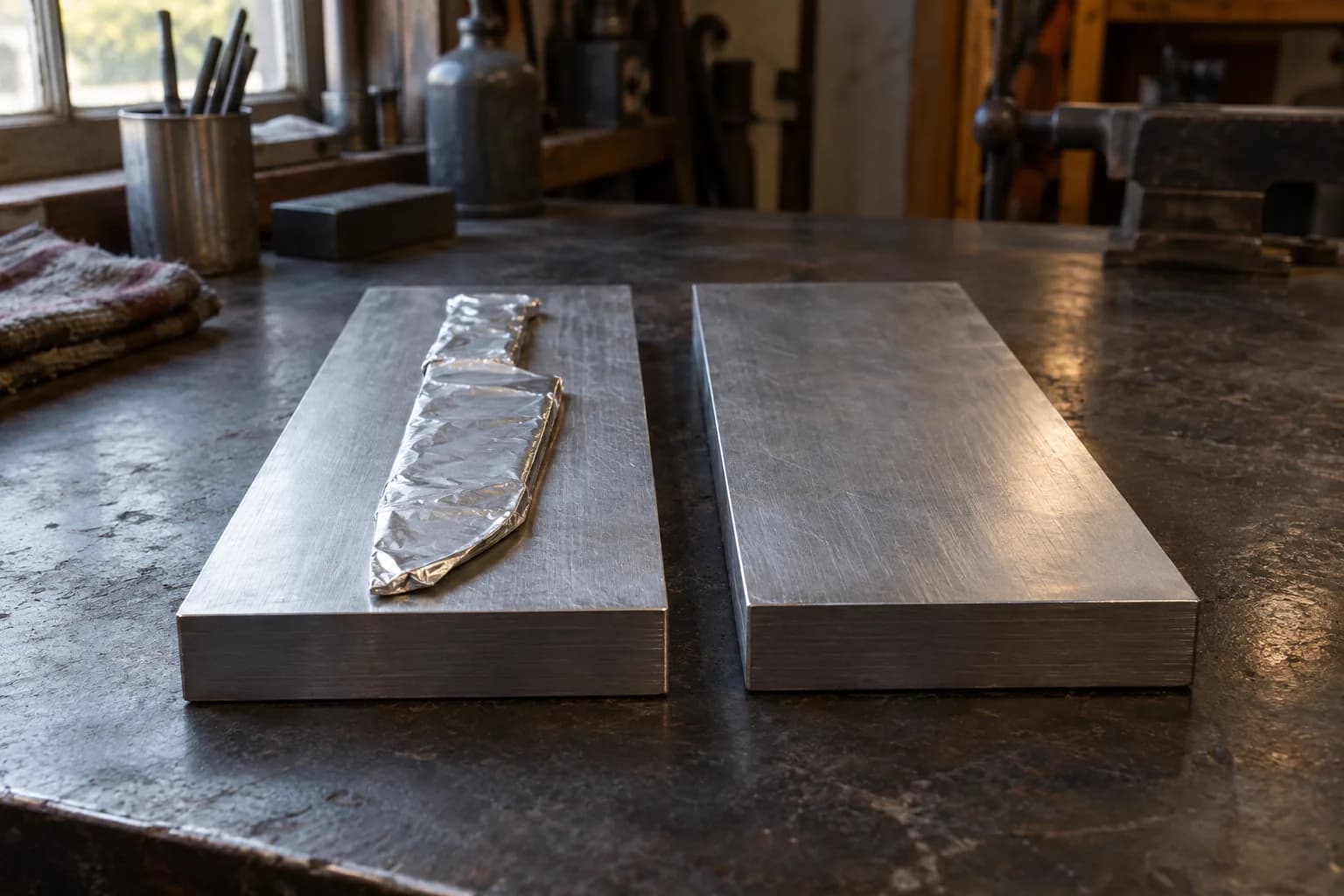
| Heat treat | Austenitize 1950°F, 10–15 min soak. Plate quench between aluminum plates; add a cold step (freezer at minimum, liquid nitrogen ideally) before tempering to convert retained austenite. Temper 2×2h at 300–350°F for 60–62 HRC. Production practice of 58–60 HRC works but leaves performance on the table. | Austenitize between 1940-1975 F (soak roughly 15 minutes at 1940 F, or as little as 5 minutes at 1975 F), then plate or air quench. An optional cryogenic treatment (liquid nitrogen) can push peak hardness from around 62 HRC to roughly 64 HRC. Temper at least twice, 2 hours each cycle, in the 350-450 F range depending on desired final hardness, tempering immediately after quench or cryo. | Nearly the same recipe: high austenitize (AEB-L ~1900–1975°F, 14C28N ~1950°F), plate quench, cold treatment, low temper. Both reward liquid nitrogen and both punish skipped cold steps with retained austenite. No meaningful difficulty difference — if you can treat one, you can treat the other. |
|---|
| Grinding | 5/5As friendly as hardenable stainless gets: fine structure, no carbide tear-out, cuts cleanly on ceramics, hand-sands better than almost any other stainless, and finishes crisply. Belt life is good and the steel telegraphs no surprises. | 5/5One of the easiest stainless steels to grind and finish available to knifemakers, with no large hard carbides to fight through. A common recommendation for makers just starting to work with stainless steel. | Indistinguishable on the belt: both are the friendliest stainless steels a 2x72 will meet — clean cutting, fine finishing, honest feedback. Both hand-sand unusually well for stainless. Buy whichever is in stock in your thickness. |
|---|