| Toughness | 5/5Excellent, and the reason the steel is worth taking seriously on its own. Roughly 2% nickel refines grain and improves impact resistance, while the near-total absence of alloy carbides removes the usual crack-initiation sites. This is what lets you run 15N20 at 61–62 HRC and still grind it thin without chipping. | 4/5Very good for a simple carbon steel, and a big part of why it is so widely recommended: it holds up well to impact without the brittleness risk that comes with over-hardened, lower-manganese steels like 1095. | 15N20 wins clearly. Roughly 2% nickel refines grain and improves impact resistance, so 15N20 stays tough even at 61 to 62 HRC where 1084 would be getting brittle. In a welded billet the pairing lands between the two, following the weaker partner more closely than the stronger one. |
|---|
| Edge retention | 3/5Better than its plain chemistry suggests, because in low-carbide steels edge retention tracks hardness — and 15N20's toughness lets it live at 61–62 HRC where 1084 typically runs 58–60. It will not out-slice a carbide-rich steel like D2, but against the simple carbon steels it holds a keen edge longer than expected. | 2/5Modest, in line with other simple carbon steels lacking wear-resistant alloy carbides, but it takes a very keen edge easily. | 15N20, by way of hardness rather than chemistry. Neither steel has meaningful alloy carbides, so edge life tracks hardness — and 15N20's toughness lets it live at 61 to 62 HRC while 1084 typically runs 58 to 60. Same carbide story, better operating point. |
|---|
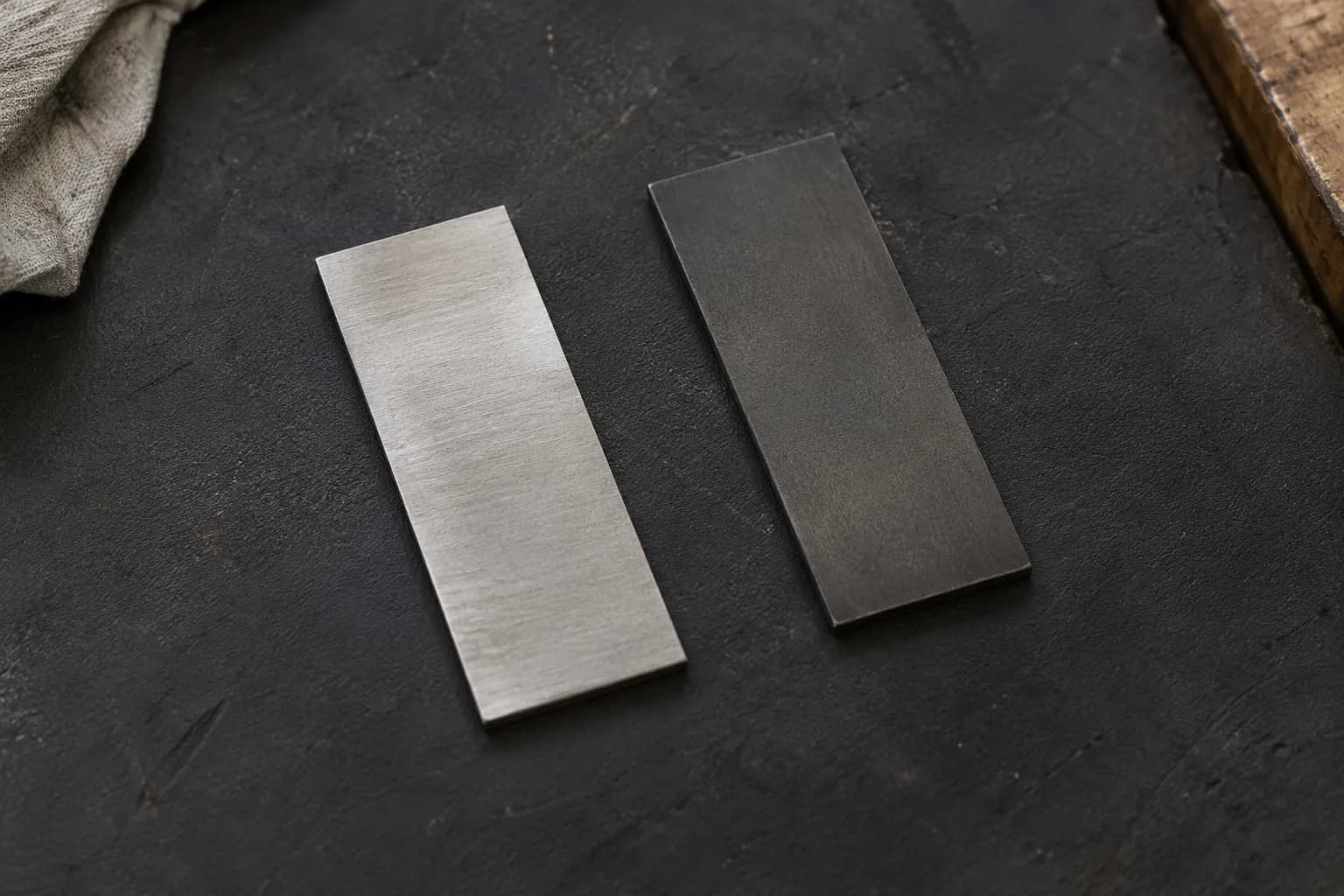
| Corrosion resistance | 2/5Slightly better than plain carbon steel, entirely thanks to the nickel — the same trait that keeps it bright in a ferric chloride etch slows ordinary staining a little too. It is not stainless and it is not close. Dry it, oil it, and expect a patina on a working blade. | 1/5No chromium and no meaningful corrosion resistance. Needs regular oiling and drying like any plain carbon steel. | 15N20 is slightly better, and this is the entire reason the pair works visually. Nickel resists ferric chloride, so in an etch the 1084 goes dark and the 15N20 stays bright silver. In a kitchen sink, neither is stainless and both need drying. |
|---|
| Heat treat | Normalize and thermal cycle if forged or damascus-welded. Austenitize at 1475–1500°F with a 10 minute soak, then quench in a fast oil (Parks 50 class) — hardenability is moderate, so speed matters, especially in thin sections. Temper twice for two hours at 300–400°F: 300–350°F holds 61–62 HRC for thin kitchen blades, 400°F backs down to about 59–60 for harder-use work. | Optionally normalize at 1607-1652 F to refine grain and relieve stress after forging or heavy machining. Austenitize at 1500-1525 F, holding 5-15 minutes, then quench in preheated oil (around 104-140 F) for reliable, full hardness thanks to 1084's higher manganese content. Temper starting around 350 F, going up to about 450 F depending on desired hardness; for general hunting and utility blades, 375-425 F for 2 hours across 2-3 cycles is a common recommendation, letting the blade cool to room temperature between cycles. | Almost identical, which is exactly why they are welded together. Both austenitize around 1475 to 1500°F and quench in fast oil. The only real divergence is tempering: 1084 usually gets 400 to 425°F, while 15N20 can be tempered lower at 300 to 350°F to hold its higher hardness. A damascus billet of the two is heat treated as if it were 1084. |
|---|
| Grinding | 4/5Easy on belts and files in the annealed state, and forgiving under heat because there are no coarse carbides to tear out. Most commonly sold in thin stock (0.060–0.125"), which grinds fast but also heats fast — keep it moving and dip often. | 5/5Extremely easy to grind and forge, one of the most forgiving steels available for both stock removal and forging work. | Both are easy. 15N20 is usually sold in thin stock, so it heats quickly on the belt and needs frequent dipping. Welded damascus of the two grinds as one steel, though the nickel layers show up differently under a hand-sanding progression. |
|---|