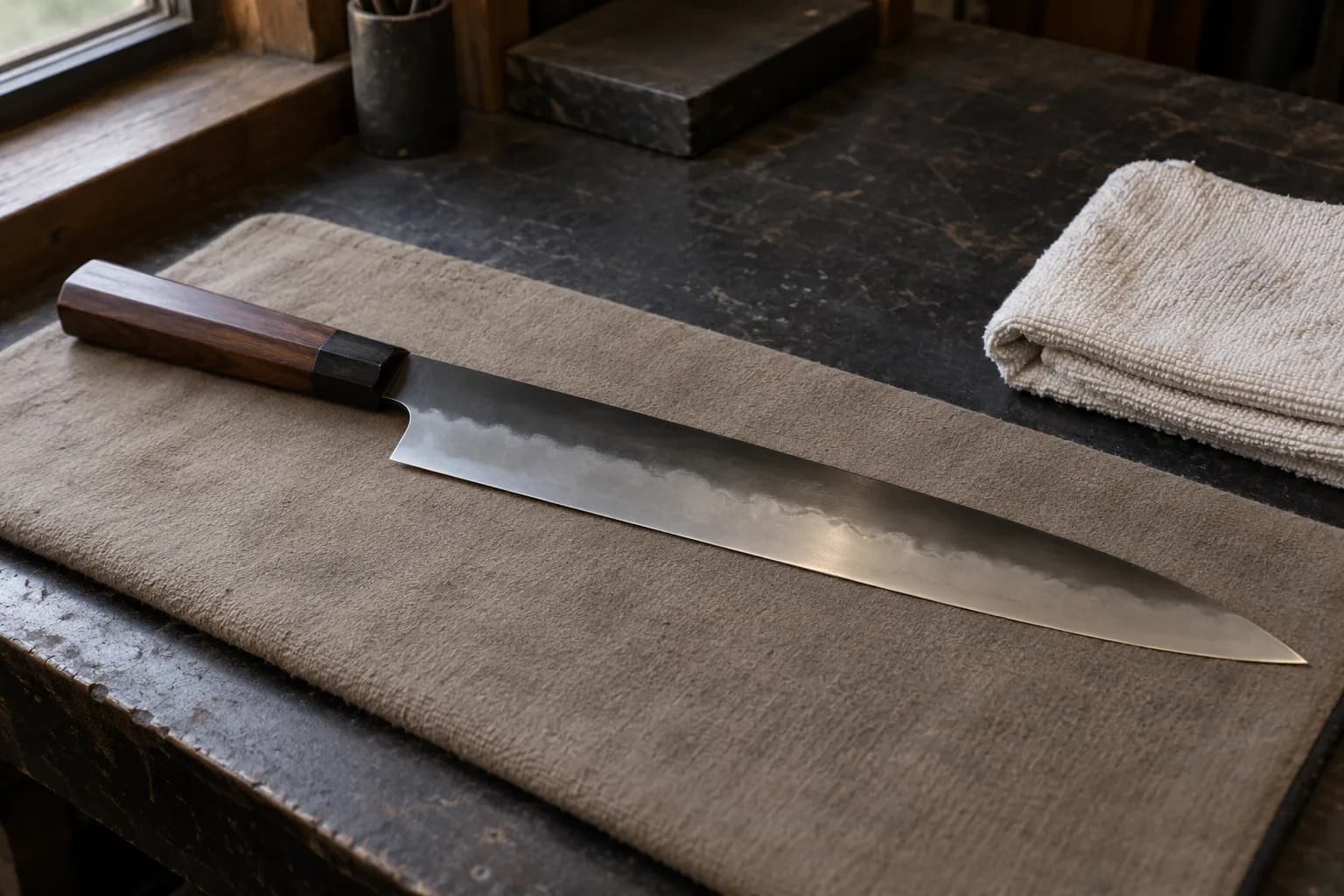
| Toughness | 2/5Through-hardened W2 sits in 1095 territory — high carbon, moderate at best, and not a chopper steel. The honest asterisk: a clay-quenched W2 blade behaves far tougher than its number, because the soft pearlite spine bends where a through-hardened blade breaks. Rate the steel a 2; rate a well-made hamon blade higher. | 4/5Noticeably tougher than plain carbon steels like 1095 or O1, thanks to its very fine, clean grain structure inherited from its bearing-steel origins. | 52100 clearly, through-hardened — its lower carbon-in-solution and fine structure deliver genuine toughness W2 cannot match hardened all the way through. Clay-quenched W2 narrows the gap by putting a pearlite spine behind the hard edge, but as monolithic steels this is 52100's category. |
|---|
| Edge retention | 2/51095-class wear resistance — fine cementite, no meaningful alloy carbide, so it sharpens fast and dulls faster than alloyed steels. The vanadium's fine grain means the apex it takes is exceptionally keen, which is most of why razor and kitchen smiths tolerate the maintenance. | 3/5Chromium carbides give it a real step up in wear resistance over plain carbon steel, and its fine grain lets it hold a very keen edge, though it is still well short of high-carbide stainless steels. | 52100 by a modest margin: chromium carbides add wear resistance W2's near-pure cementite lacks, and both take excellent fine apexes. Neither embarrasses the other; both resharpen quickly and reward stropping. |
|---|
| Corrosion resistance | 1/5None. W2 rusts as eagerly as 1095 — flash rust on a fresh grind, spots overnight in a humid shop. Oil it, dry it, and remember the etch that reveals a hamon is controlled corrosion: the same reactivity that shows the line will eat the blade if neglected. | 1/5The 1.3-1.6% chromium is there for hardenability and carbide structure, not corrosion resistance. Treat it like a carbon steel and keep it oiled and dry. | Both rust; W2 rusts faster. 52100's ~1.5% chromium slows the process slightly but does not approach stainless behavior. Same care rules for both: oil, dry, patina. |
|---|
| Heat treat | Normalize 1600°F, cycle down (1475°F, then 1450°F). Austenitize 1425–1475°F — 1450°F typical — short soak. Quench in fast oil (Parks 50 class); water is traditional and dramatic but cracks blades. For a hamon: 1.5mm or less of satanite on the spine before the hardening heat. Temper 2×2h at 350–400°F (60–62 HRC) or 450°F for hard-use blades (58–59). The window is narrow — undershoot and it stays soft, overshoot and the hamon vanishes. | If working from reclaimed bearing races, a normalize at 1700 F followed by a grain-refining anneal at 1460 F is common before hardening. Austenitize at 1500-1525 F for about 15 minutes, then quench in a fast oil such as Parks AAA (medium-speed oil can work on thinner stock). As-quenched hardness can reach the mid-60s Rc. Temper between 300 and 400 F: the lower end favors maximum hardness and edge stability, the higher end favors toughness, with most knife applications landing around 60-62 Rc. | 52100 is the fussier forge steel — it loves multiple normalizing cycles and rewards a practiced schedule, but its deeper hardenability makes the quench itself forgiving in medium oil. W2 inverts that: simple cycles, but a narrow austenitizing window and a mandatory fast oil. And only W2 does clay: 52100's hardenability steamrolls a hamon. |
|---|
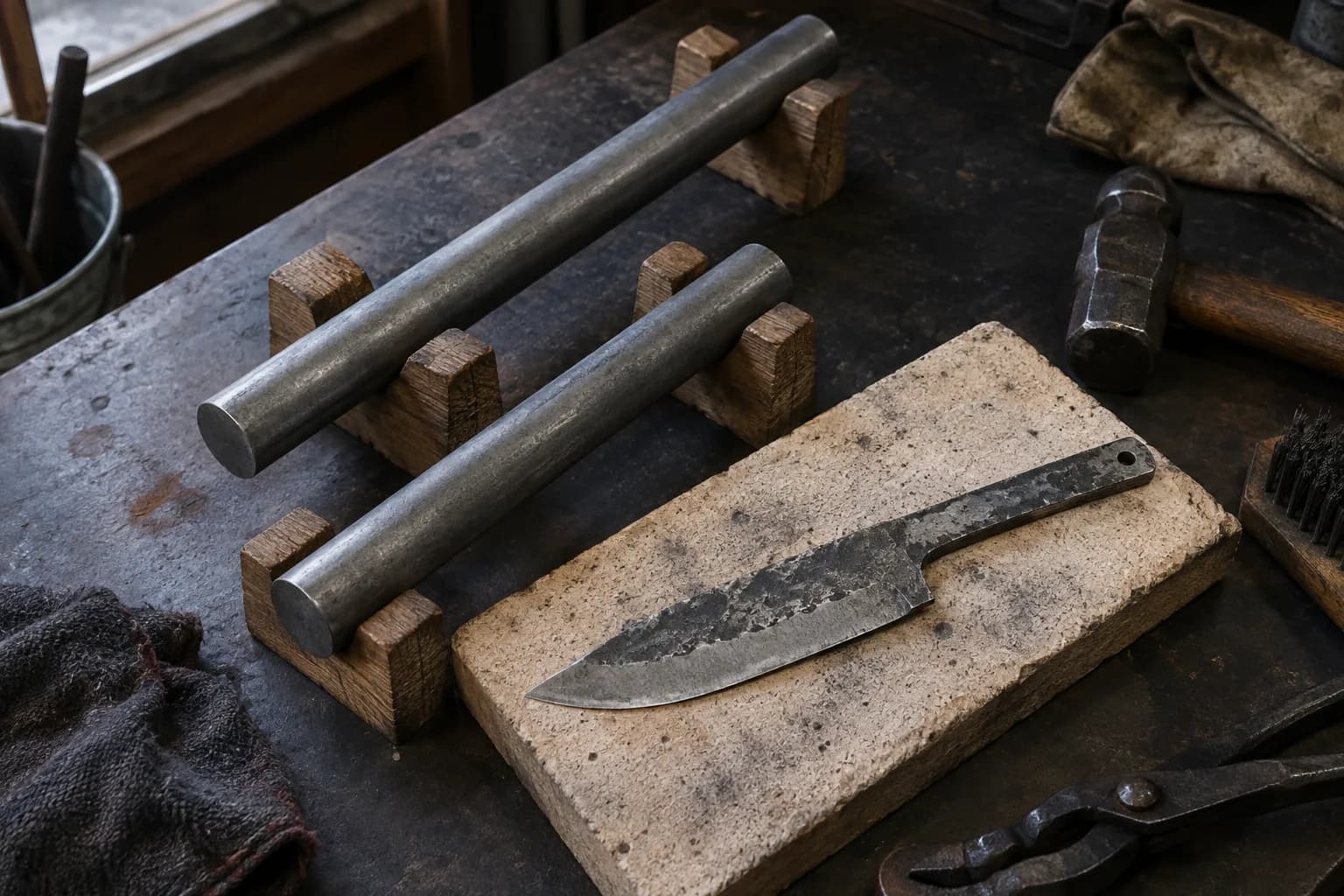
| Grinding | 4/5Annealed W2 files, drills and grinds cooperatively, and it forges beautifully — it moves under the hammer like 1095 with better grain manners. Docked a point only because knife-quality W2 comes and goes from suppliers in rounds and odd flats, so stock prep can involve more forging than a precision-ground steel. | 4/5Grinds and forges well, though the chromium carbides make it slightly slower to work than simple steels like 1084 or 1075. | Close to a tie. Both grind cooperatively annealed and behave predictably hardened, with the usual low-temper heat caution. 52100 is widely available as round bar (bearing stock) that wants forging; knife-grade W2 has the same problem plus scarcer supply — call it 52100 by a logistics nose. |
|---|