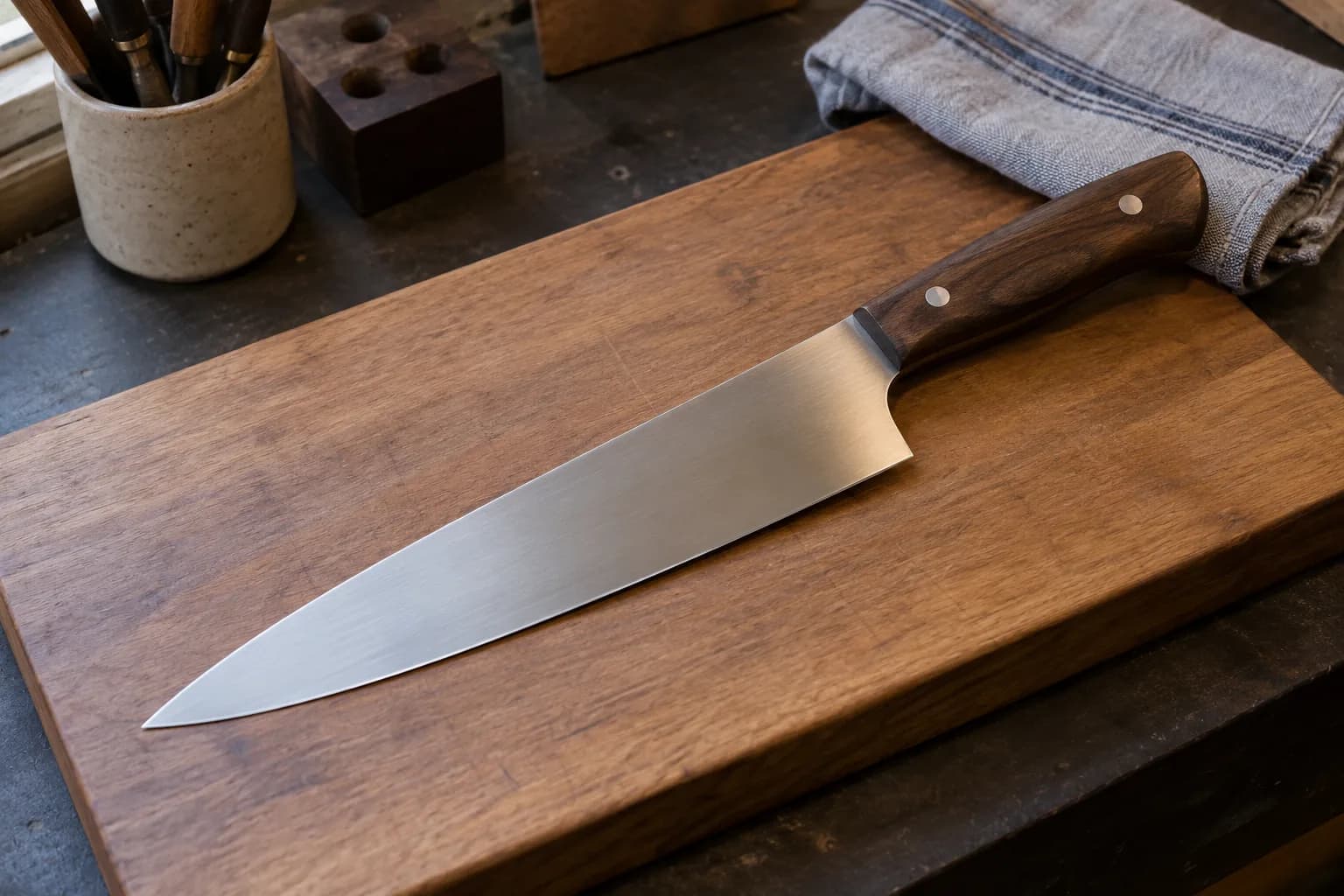
| Toughness | 2/5The known tradeoff. High carbide volume means M390 sits well below MagnaCut, AEB-L or CPM 3V in impact toughness - fine for folders and slicers, wrong for choppers and prying. Among its wear-class peers it is respectable (slightly tougher than 20CV in some testing), but keep edges at sensible angles and uses honest. | 2/5The tradeoff for its extreme wear resistance: with a heavy carbide load it is more prone to micro-chipping than tougher steels like CPM 3V or CruWear. On the toughness table in Crucible's MagnaCut data sheet (Charpy C-notch) it is last, 15 ft-lbs at 62 HRC against 25 for CPM S35VN at 61 HRC and 36 for CPM 4V at 62 HRC. That 62 HRC is above the 56-59 HRC Crucible gives as typical service hardness for 20CV; Larrin Thomas's 2140°F test cycle reaches about 61 Rc. | Statistically even, with some testing giving M390 a slight chipping-resistance edge at equal hardness - a margin smaller than heat-treat variation between two shops. Both sit in the modest-toughness super-stainless class: fine for folders and slicers, wrong for impact. |
|---|
| Edge retention | 5/5The reason it exists. Dense vanadium and chromium carbides deliver CATRA and real-world cutting endurance near the top of the stainless chart - only the extreme-vanadium steels like S90V clearly out-wear it. At 61-62 HRC a thin M390 edge cuts abrasive media for a very long time. | 5/5Exceptional wear resistance from a very heavy chromium and vanadium carbide load, among the best edge retention available in a knife steel. | A tie by design - same ~1.9% carbon, 4% vanadium, 20% chromium carbide chemistry, same CATRA-class results at equal hardness. Any difference you can measure came from hardness targets, not chemistry. |
|---|
| Corrosion resistance | 5/5Larrin Thomas rates M390 9 out of 10 for corrosion resistance; his ratings table gives M390, CPM 20CV and CTS 204P one shared score. That sits behind MagnaCut (9.5) and LC200N and Vanax (10) and ahead of Elmax and S45VN (8) and S35VN, S30V and S90V (7.5). With 20% chromium it is a top-tier stainless and resists rust very well in everyday wet and humid use, but it is not rustproof and not a saltwater steel: Thomas puts saltwater-level corrosion resistance with LC200N and Vanax only, and his MagnaCut article reports MagnaCut as even better than M390. Wipe it dry after salt exposure, and choose LC200N or Vanax for constant immersion. | 5/5Larrin Thomas rates CPM 20CV 9 out of 10 for corrosion resistance, behind MagnaCut (9.5) and LC200N and Vanax (10) and ahead of Elmax (8) and S35VN and S30V (7.5). About 20% chromium makes it a top-tier stainless: Crucible's 72-hour 1% saltwater spray chart shows only about 2 rust spots on 20CV, and in Thomas's own test a couple of small spots appeared where MagnaCut showed none. It suits wet and humid conditions, but it is not a saltwater steel: wipe it dry after salt exposure, and choose LC200N or Vanax for constant immersion. | A tie, on the scores above and on Larrin Thomas's ratings table: M390, CPM 20CV and CTS 204P share one row at 9 out of 10, so both pills read 5. Both are comfortably stainless for EDC, kitchen and weather duty. The records differ only in salt-spray data: Crucible's 72-hour 1% saltwater chart shows about 2 rust spots on 20CV, but M390 is not on that chart, so the figure is not carried over to it. Neither is a saltwater steel: Thomas puts that level with LC200N and Vanax (10), so choose one of those for constant salt exposure, and wipe either steel dry after wet or salty use. |
|---|
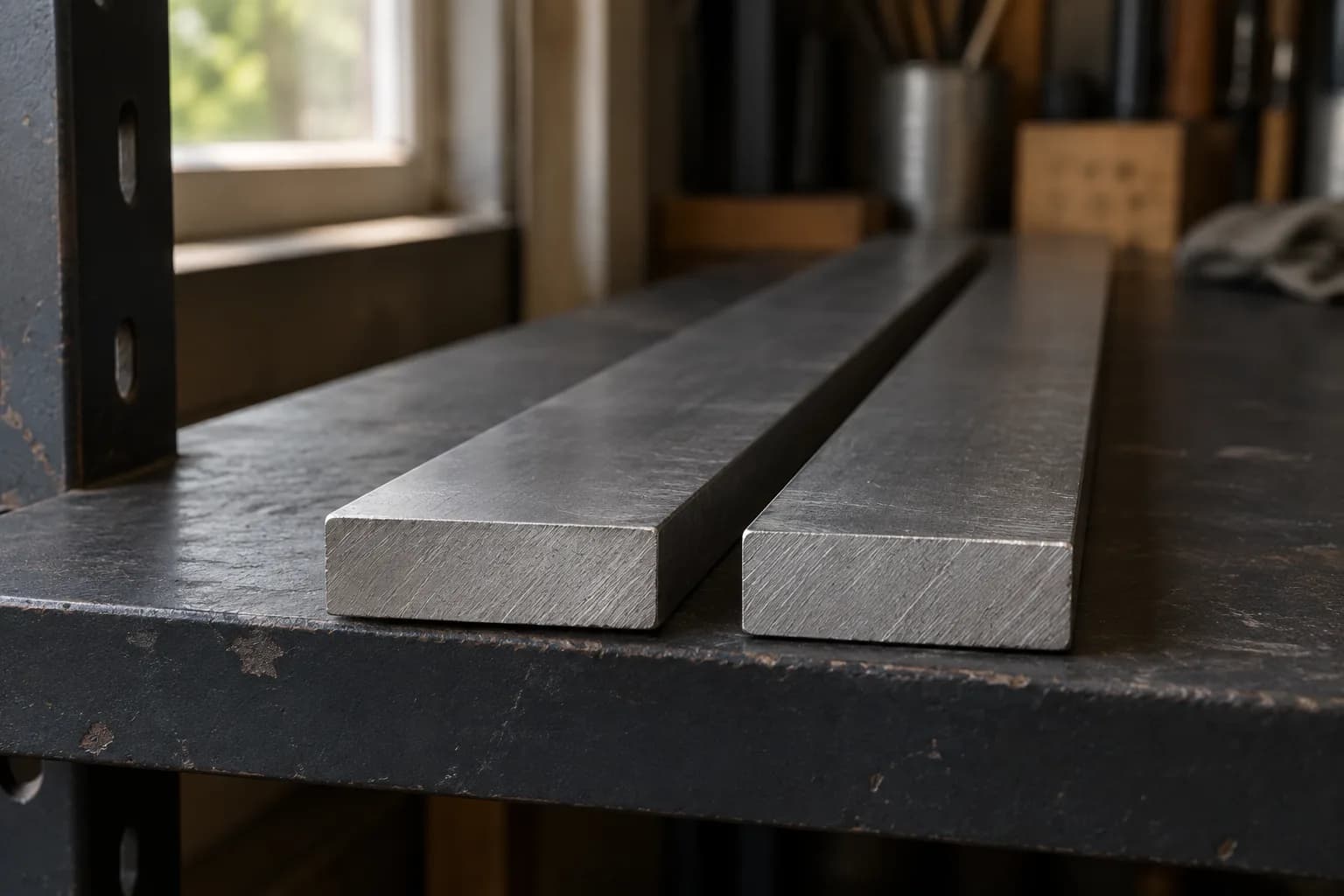
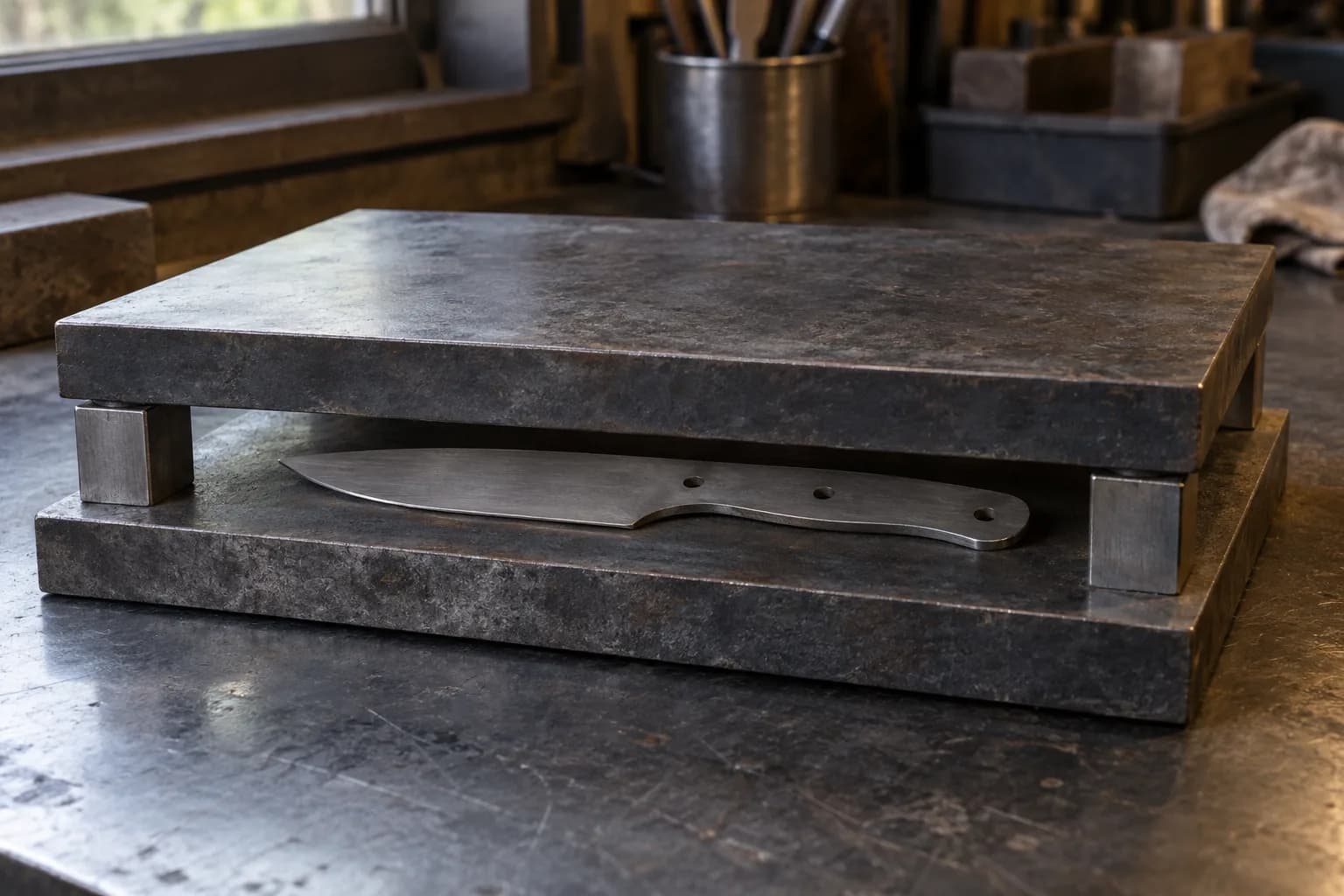
| Heat treat | Stock removal only, and a controlled kiln is non-negotiable; send it out otherwise. Bohler's own paperwork sets the cycle: the M390 MICROCLEAN data sheet (EN_GB, 09.2026) and the M390 brochure (M390EN, 05.2019). Austenitize at 1100-1180°C (2010-2155°F), holding 20-30 minutes after through-heating at 1100-1150°C (2010-2100°F) and 5-10 minutes at 1151-1180°C (to 2155°F), and quench quickly (oil or nitrogen). Cool to about 30°C (86°F); the data sheet then allows a deep freeze of 2 hours at -80°C (-112°F), the brochure recommends a subzero step for the highest wear resistance (its charts use -70°C, -95°F, for 2 hours, and it warns of stress-cracking risk when freezing straight after a 1150°C / 2100°F or hotter austenitize), and tempering follows immediately, each temper at least 2 hours (the charts use two 2-hour tempers). Bohler names 200-300°C (390-570°F) tempers for the highest corrosion resistance, and 510-530°C (950-990°F) with subzero or 540-560°C (1000-1040°F) without, tempered three times, for the highest wear resistance. Its tempering charts (1150°C / 2100°F for 30 minutes, nitrogen at 5 bar, small test pieces), read by eye, give about 62 HRC at a 100-150°C (210-300°F) temper without subzero and about 63-64 with it; about 60.5 HRC without and 62 with at 175°C (350°F); and at the recommended 200-300°C (390-570°F) tempers about 59 falling to 57 HRC without subzero and about 61.5 to 61 HRC with it. A knife-maker's low temper therefore lands near 60-62 HRC; Larrin Thomas's 2140°F (inside Bohler's window), plate quench, cryo and 365°F test cycle read about 62 Rc. Chart values are laboratory figures on small specimens, so confirm the hardness on your own blades. | Crucible's CPM 20CV data sheet: preheat to 1400-1450°F, heat rapidly to an austenitizing temperature within 1960-2150°F (1071-1177°C) and soak for 30 minutes, using a vacuum furnace between 2050°F and 2150°F; a lower temperature favors toughness and a higher one wear and corrosion resistance. Quench with pressurized gas (4 bar minimum) or warm oil, then temper immediately, typically at 400-800°F for at least 2 hours. Crucible lists a typical service hardness of 56-59 HRC, says higher hardness may be used for more wear resistance, and recommends a cryogenic treatment after the quench when austenitizing at 2100°F or higher. Larrin Thomas's independent test recipe differs from Crucible's: 2140°F austenitize, plate quench, cryo, 365°F temper, which gave about 61 Rc for 20CV (read from his chart). It sits inside Crucible's austenitizing range but tempers below Crucible's typical 400°F minimum. Because this steel demands precise, high-temperature equipment and a controlled quench, it is best suited to makers with a programmable oven or a professional heat-treating service. | Same protocol family, and the makers' own paperwork lines up. Bohler's M390 MICROCLEAN data sheet (EN_GB, 09.2026) and brochure (M390EN, 05.2019) give a 1100 to 1180°C (2010 to 2155°F) austenitize, a quick quench, a subzero step (recommended for the best wear resistance) and tempers at 200 to 300°C (390 to 570°F) for the best corrosion resistance. Its tempering charts, read by eye, show about 59 down to 57 HRC at those tempers without subzero and about 61.5 to 61 HRC with it. Crucible's 20CV sheet allows 1960 to 2150°F and tempers at 400 to 800°F, lists a typical service hardness of 56 to 59 HRC and recommends a cryogenic treatment from 2100°F up; its response charts, read by eye, show the cryo curves holding roughly 60 to 62 HRC through tempers up to 600°F. So at the makers' own tempers both steels sit near 56 to 59 HRC without a freeze and 60 to 62 with one. The lower-temper hardness comes from a test cycle: Larrin Thomas ran both steels through 2140°F, plate quench, cryo and a 365°F temper and read about 62 Rc for M390 and about 61 Rc for 20CV off his toughness chart (Bohler's chart reads about 62 HRC for M390 at a comparable 185°C temper with subzero, on a 2100°F austenitize). That is his cycle, not either maker's recommendation. Follow Crucible's sheet for 20CV and Bohler's for M390, and read the two cells above for each steel's figures. |
|---|
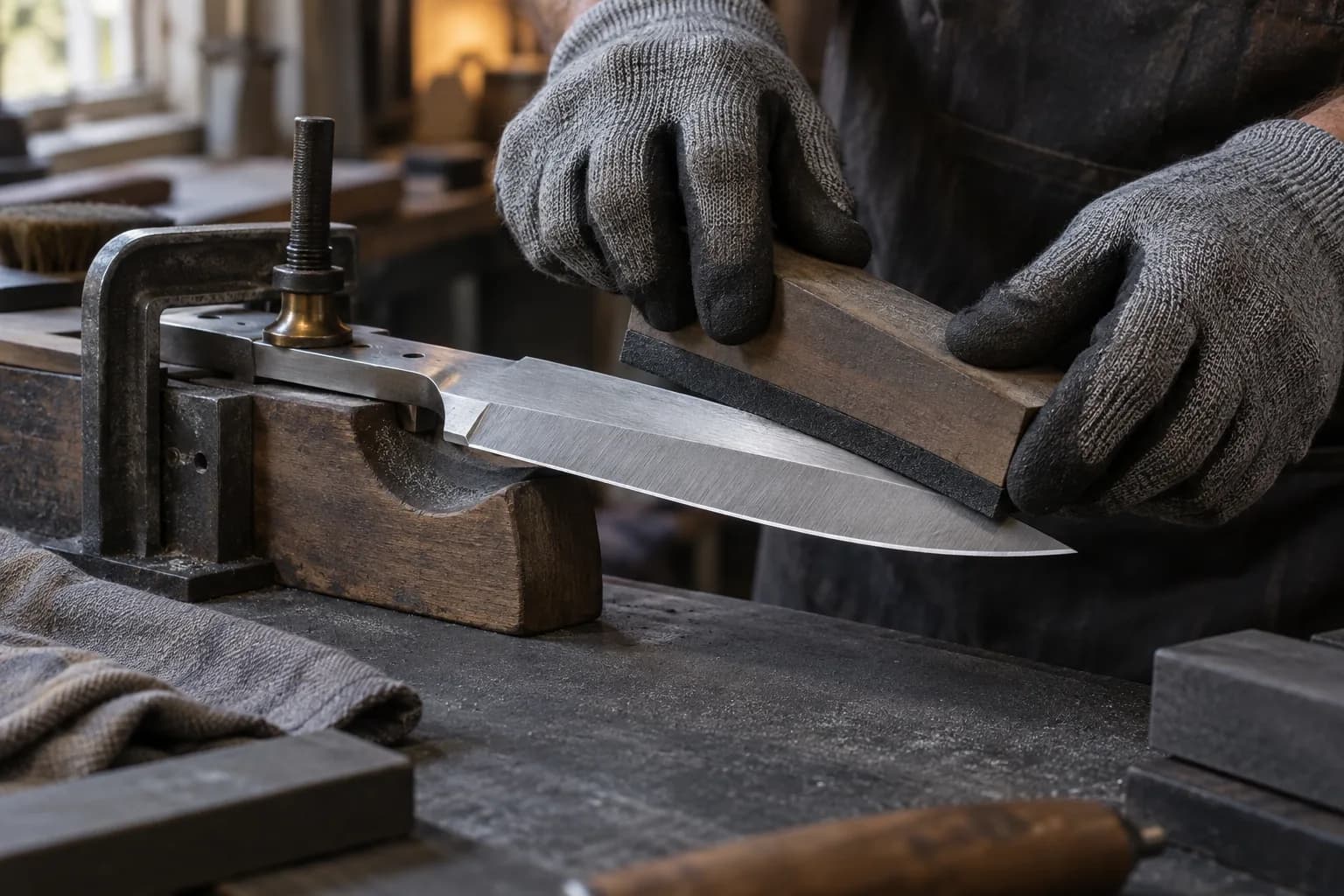
| Grinding | 2/5A belt-eater. Annealed stock grinds and drills manageably with sharp ceramic belts and carbide tooling, but hardened M390 laughs at worn abrasives and conventional stones - budget ceramic belts for grinding and diamond/CBN for sharpening. Heat builds fast in thick sections; keep passes light and water close. | 2/5Demanding to grind and sharpen; typically requires diamond or CBN abrasives to sharpen efficiently once fully hardened, more challenging than most other steels in this database. | Equally demanding: ceramic belts while annealed, diamond or CBN once hard, patience throughout. No meaningful difference at the grinder or the sharpening bench - the powder practice of both mills produces similarly fine, similarly stubborn carbide structures. |
|---|