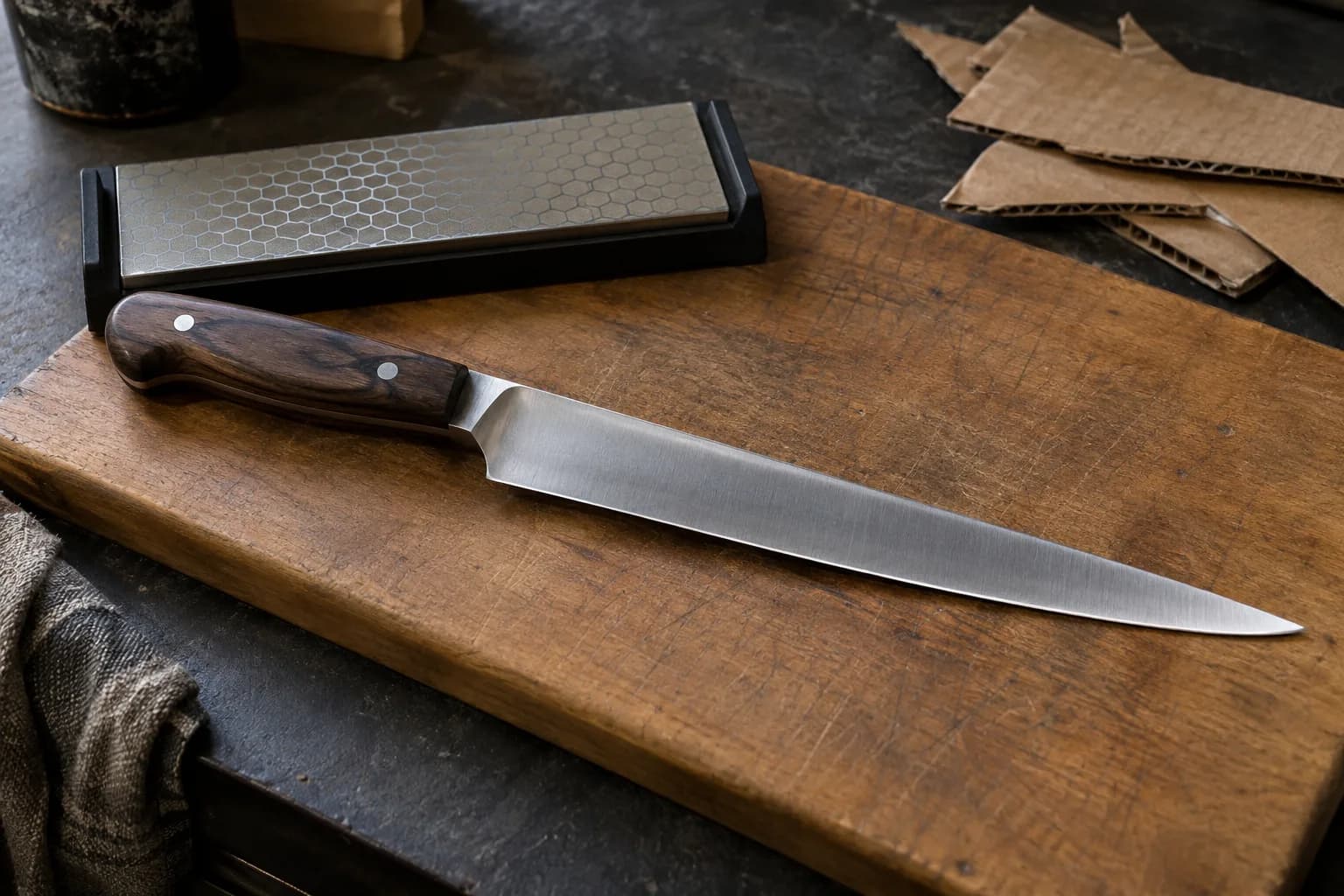
| Toughness | 1/5The bill for the vanadium. S90V sits near the bottom of the stainless toughness chart - thin edges chip on impact, tips do not tolerate prying, and batoning is out of the question. Geometry compensates: keep angles at 18-20 dps and duty strictly slicing and it behaves for years. | 2/5The known tradeoff. High carbide volume means M390 sits well below MagnaCut, AEB-L or CPM 3V in impact toughness - fine for folders and slicers, wrong for choppers and prying. Among its wear-class peers it is respectable (slightly tougher than 20CV in some testing), but keep edges at sensible angles and uses honest. | M390, clearly. Neither is tough by general standards, but S90V's 9% vanadium carbide volume puts it at the bottom of the stainless chart - thin edges chip on staples M390 survives. Both want sensible angles; S90V demands them. |
|---|
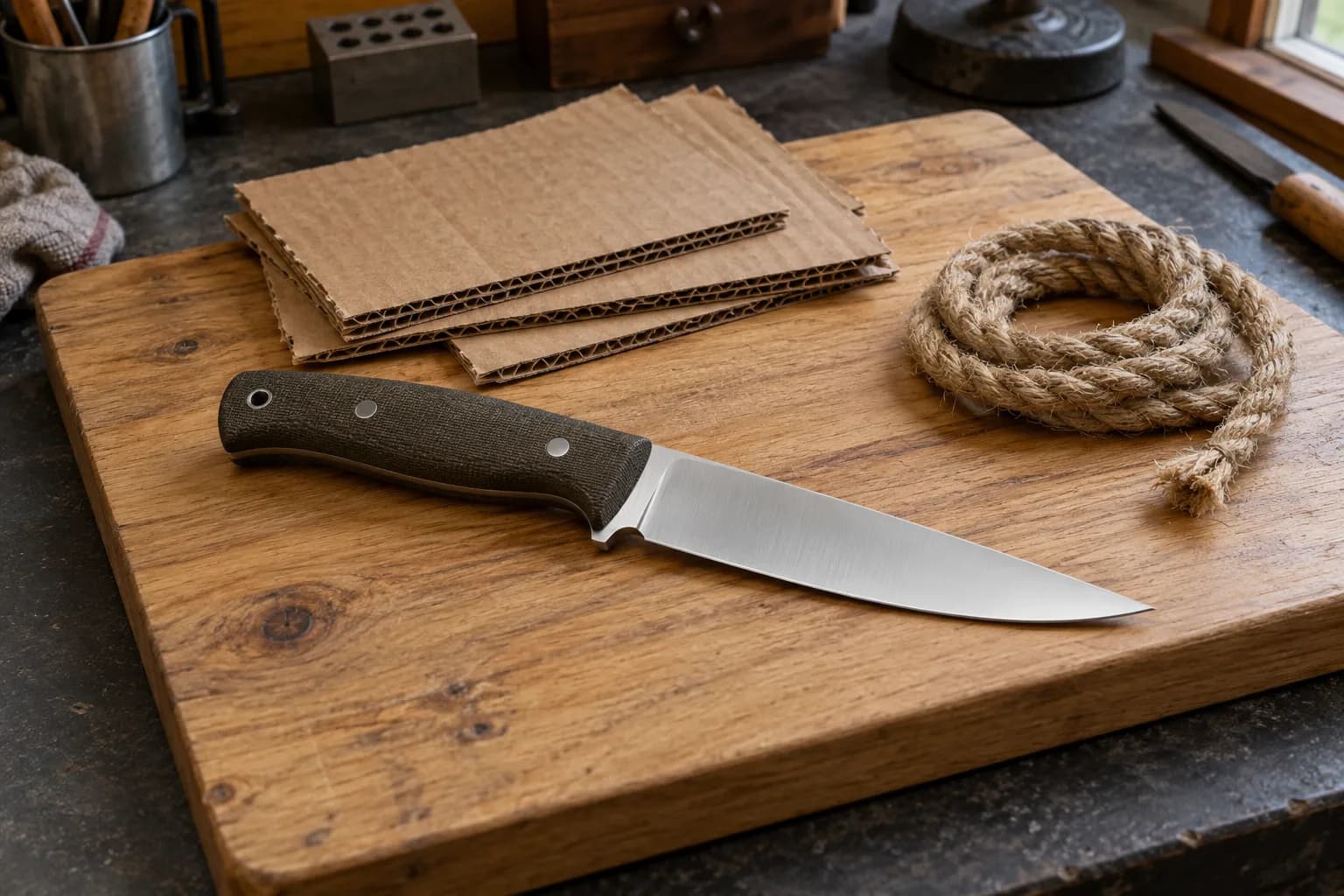
| Edge retention | 5/5The entire point, and the rating undersells it - this is the top of the stainless wear chart. Nine percent vanadium forms extremely hard MC carbides that keep a working edge through abrasive media long after M390-class steels have gone dull. In CATRA-style testing only exotic siblings (S110V, M398, Maxamet-class) keep company. | 5/5The reason it exists. Dense vanadium and chromium carbides deliver CATRA and real-world cutting endurance near the top of the stainless chart - only the extreme-vanadium steels like S90V clearly out-wear it. At 61-62 HRC a thin M390 edge cuts abrasive media for a very long time. | S90V, decisively - this is the one column it was designed to win, and CATRA-class testing puts it clearly above M390/20CV. In abrasive media (cardboard, rope) the difference is obvious in use, not just on charts. |
|---|
| Corrosion resistance | 4/5Practically stainless for EDC and kitchen life - about 14% chromium, enough free in the matrix for real protection. Below M390's margin; wipe after salt exposure and it will never trouble you. | 5/5Larrin Thomas rates M390 9 out of 10 for corrosion resistance; his ratings table gives M390, CPM 20CV and CTS 204P one shared score. That sits behind MagnaCut (9.5) and LC200N and Vanax (10) and ahead of Elmax and S45VN (8) and S35VN, S30V and S90V (7.5). With 20% chromium it is a top-tier stainless and resists rust very well in everyday wet and humid use, but it is not rustproof and not a saltwater steel: Thomas puts saltwater-level corrosion resistance with LC200N and Vanax only, and his MagnaCut article reports MagnaCut as even better than M390. Wipe it dry after salt exposure, and choose LC200N or Vanax for constant immersion. | M390, by a step: the 5 against 4 above. Larrin Thomas's ratings table gives M390 a 9 out of 10 and S90V a 7.5, a gap of one and a half points, and M390 carries 20% chromium against S90V's 14%. Both are honestly stainless for EDC and kitchen life, and neither is a saltwater steel: wipe either dry after wet or salty use, and look to LC200N or Vanax (both 10 on Thomas's table) for constant saltwater exposure. |
|---|
| Heat treat | Stock removal only, kiln required. Crucible's CPM S90V data sheet (Niagara Specialty Metals copy) gives the cycle: austenitize at 2100-2150°F (1150-1175°C) for 20 minutes, quench in salt, interrupted oil, positive-pressure gas (at least 4 bar in a vacuum furnace) or air at no less than 150°F (80°C) per minute to below 1000°F, cool to below 125°F (50°C), then double temper at 400-750°F (200-400°C), at least 2 hours each. A freezing treatment may be used between the first and second tempers if desired, the sheet says it may be necessary to minimize retained austenite at those tempers, and it must always be followed by at least one temper. The sheet's aim hardness is 56-59 HRC, and its one S90V test row is 58 HRC (19 ft-lb) after a 2050°F austenitize and a double temper at 500°F. Double tempers at 1000-1025°F are listed for stress relief and dimensional stability, not for hardness; tempering above 800°F can cost corrosion resistance and 800-1000°F is to be avoided because of embrittlement. Crucible's own CPM MagnaCut data sheet tests S90V at 61 HRC for toughness (17 ft-lb) and 61.5 HRC for CATRA edge retention (195% of 440C ESR) but states no cycle for those pieces, so hardness above the S90V sheet's 56-59 aim exists in Crucible's testing without a recipe we can quote. Ask the maker for the actual hardness and cycle. Send it out if you do not have a controlled kiln. | Stock removal only, and a controlled kiln is non-negotiable; send it out otherwise. Bohler's own paperwork sets the cycle: the M390 MICROCLEAN data sheet (EN_GB, 09.2026) and the M390 brochure (M390EN, 05.2019). Austenitize at 1100-1180°C (2010-2155°F), holding 20-30 minutes after through-heating at 1100-1150°C (2010-2100°F) and 5-10 minutes at 1151-1180°C (to 2155°F), and quench quickly (oil or nitrogen). Cool to about 30°C (86°F); the data sheet then allows a deep freeze of 2 hours at -80°C (-112°F), the brochure recommends a subzero step for the highest wear resistance (its charts use -70°C, -95°F, for 2 hours, and it warns of stress-cracking risk when freezing straight after a 1150°C / 2100°F or hotter austenitize), and tempering follows immediately, each temper at least 2 hours (the charts use two 2-hour tempers). Bohler names 200-300°C (390-570°F) tempers for the highest corrosion resistance, and 510-530°C (950-990°F) with subzero or 540-560°C (1000-1040°F) without, tempered three times, for the highest wear resistance. Its tempering charts (1150°C / 2100°F for 30 minutes, nitrogen at 5 bar, small test pieces), read by eye, give about 62 HRC at a 100-150°C (210-300°F) temper without subzero and about 63-64 with it; about 60.5 HRC without and 62 with at 175°C (350°F); and at the recommended 200-300°C (390-570°F) tempers about 59 falling to 57 HRC without subzero and about 61.5 to 61 HRC with it. A knife-maker's low temper therefore lands near 60-62 HRC; Larrin Thomas's 2140°F (inside Bohler's window), plate quench, cryo and 365°F test cycle read about 62 Rc. Chart values are laboratory figures on small specimens, so confirm the hardness on your own blades. | Same family of cycle, different sheets, and kiln territory for both (neither is forgeable): a high-temperature austenitize, a fast quench, a temper and a freeze. Crucible's S90V sheet gives a 2100 to 2150°F austenitize held 20 minutes and a double temper at 400 to 750°F, 2 hours each, with a freeze between tempers only "if desired" (it says a freeze may be necessary to minimize retained austenite at those tempers). Its aim hardness is 56 to 59 HRC, and its S90V test row is 58 HRC after 2050°F and a 500°F double temper. Bohler's M390 data sheet (EN_GB, 09.2026) and brochure (M390EN, 05.2019) give 1100 to 1180°C (2010 to 2155°F), recommend subzero for the best wear resistance and name 200 to 300°C (390 to 570°F) tempers for corrosion resistance; their charts, read by eye, show M390 at about 57.5 HRC without subzero at a 500°F temper, close to S90V's 58, and about 62 HRC at a low 210 to 300°F temper (about 63 to 64 with subzero). Crucible's own MagnaCut sheet tests S90V at 61 to 61.5 HRC but states no cycle for those pieces. So the sheets show no hardness gap between the two at a 500°F temper; M390's published route to about 62 is a lower temper, and S90V's sheet prints no S90V figure below 500°F. Ask the maker for the actual hardness and cycle. |
|---|
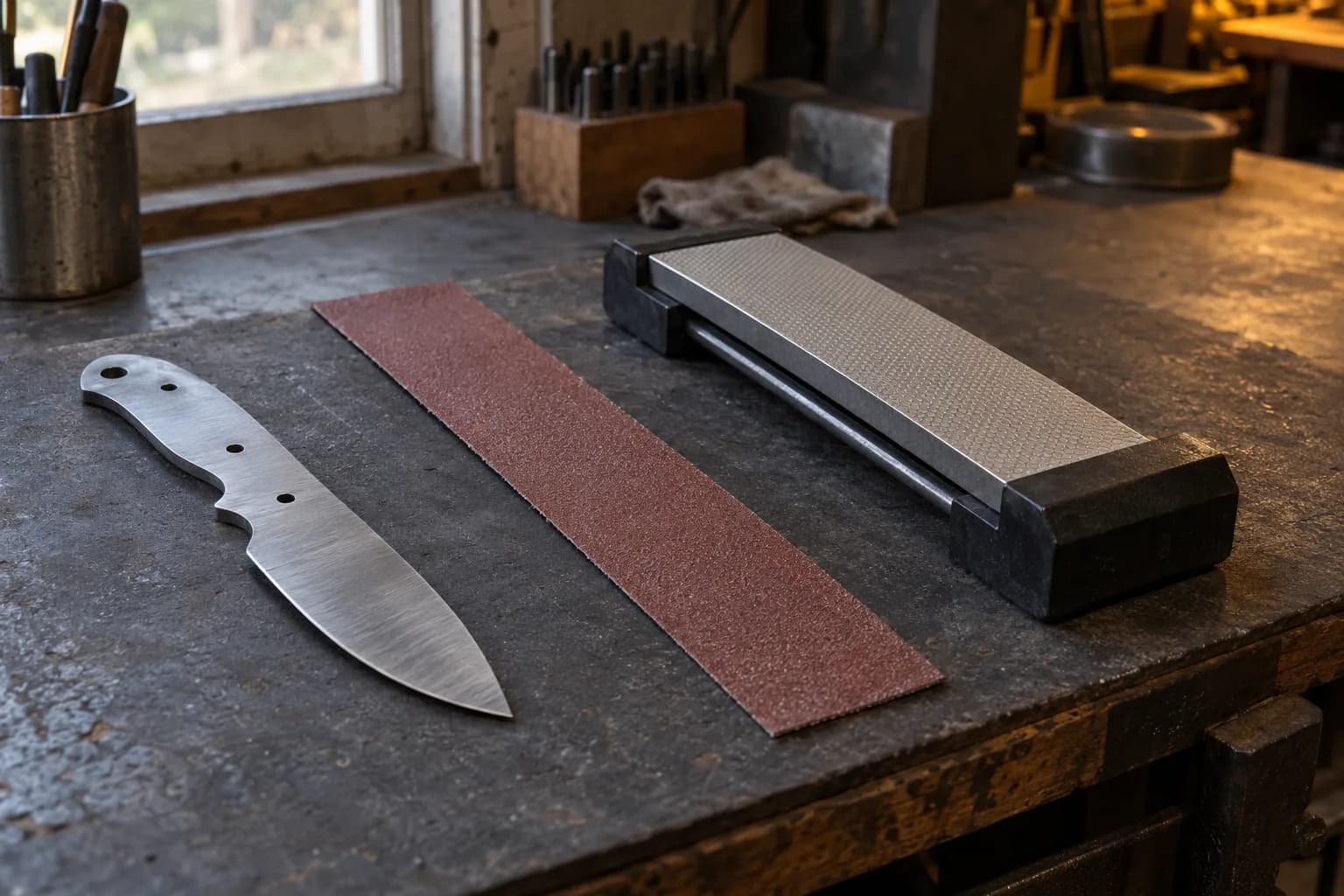
| Grinding | 1/5The shop pays for the edge. Annealed S90V drills and grinds slowly even with sharp ceramics; hardened, it defeats conventional abrasives outright - fresh ceramic belts for grinding, diamond/CBN for every sharpening task. Budget double the belts and triple the patience of a normal stainless, and keep it cool: burning an edge you spent this long grinding hurts twice. | 2/5A belt-eater. Annealed stock grinds and drills manageably with sharp ceramic belts and carbide tooling, but hardened M390 laughs at worn abrasives and conventional stones - budget ceramic belts for grinding and diamond/CBN for sharpening. Heat builds fast in thick sections; keep passes light and water close. | M390 is hard work; S90V is a commitment. Nine percent vanadium defeats conventional abrasives outright - ceramic belts for shaping, diamond/CBN mandatory for sharpening, roughly double the shop time of M390. Factor the labor into the price of every S90V blade. |
|---|