
Damascus & Pattern Welding
How Damascus Is Actually Made: Your First Pattern-Welded Billet
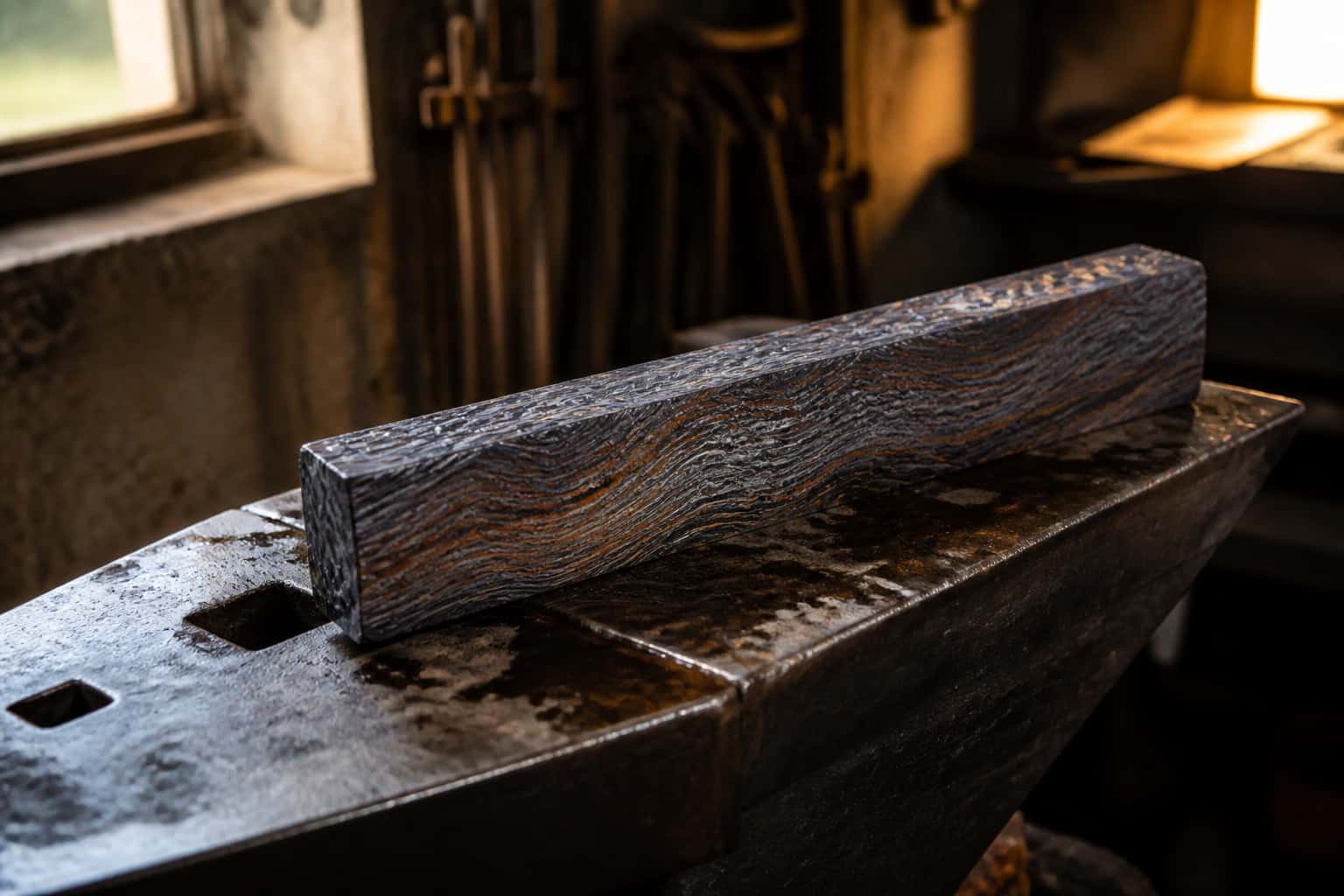
Modern “damascus” is pattern-welded steel: two different steels stacked, forge welded into one solid billet, and manipulated so that grinding and etching…
Damascus & Pattern Welding
The real story: pattern-welded damascus was never lost; wootz crucible steel was - and vanadium traces in Indian ore turned out to be the secret.
3 min readWritten by Rich LinvilleFree to read
“Is damascus steel real, or is the secret lost?” It’s one of the most-argued questions in the knife world, and the confusion comes from one word covering two completely different steels. Short version: the layered damascus made today is real, historical, and never went anywhere — while the legendary “true damascus” of ancient sword fame is a different material called wootz, whose production genuinely did die out and whose secret took modern science until the 1990s to crack.
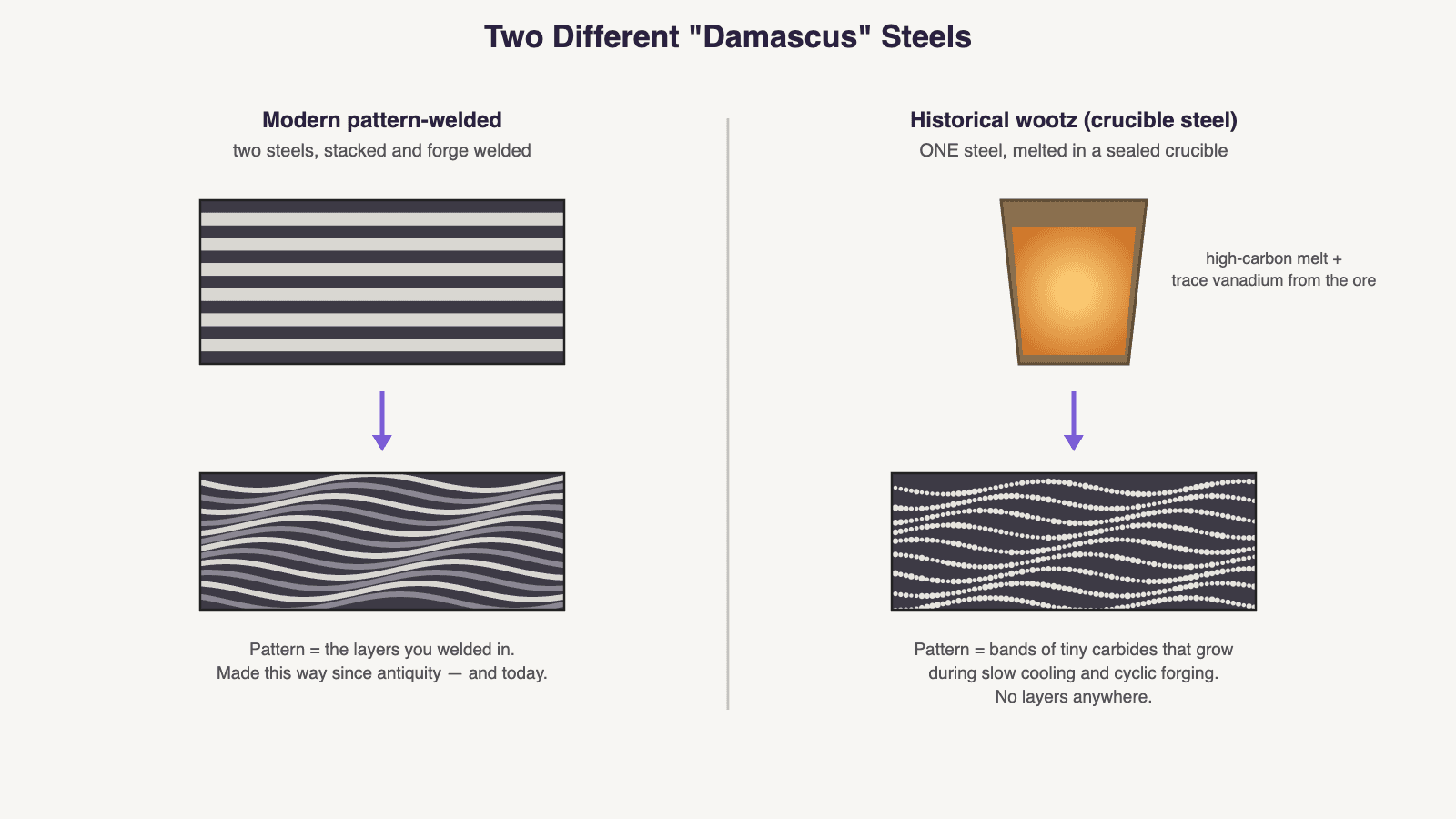
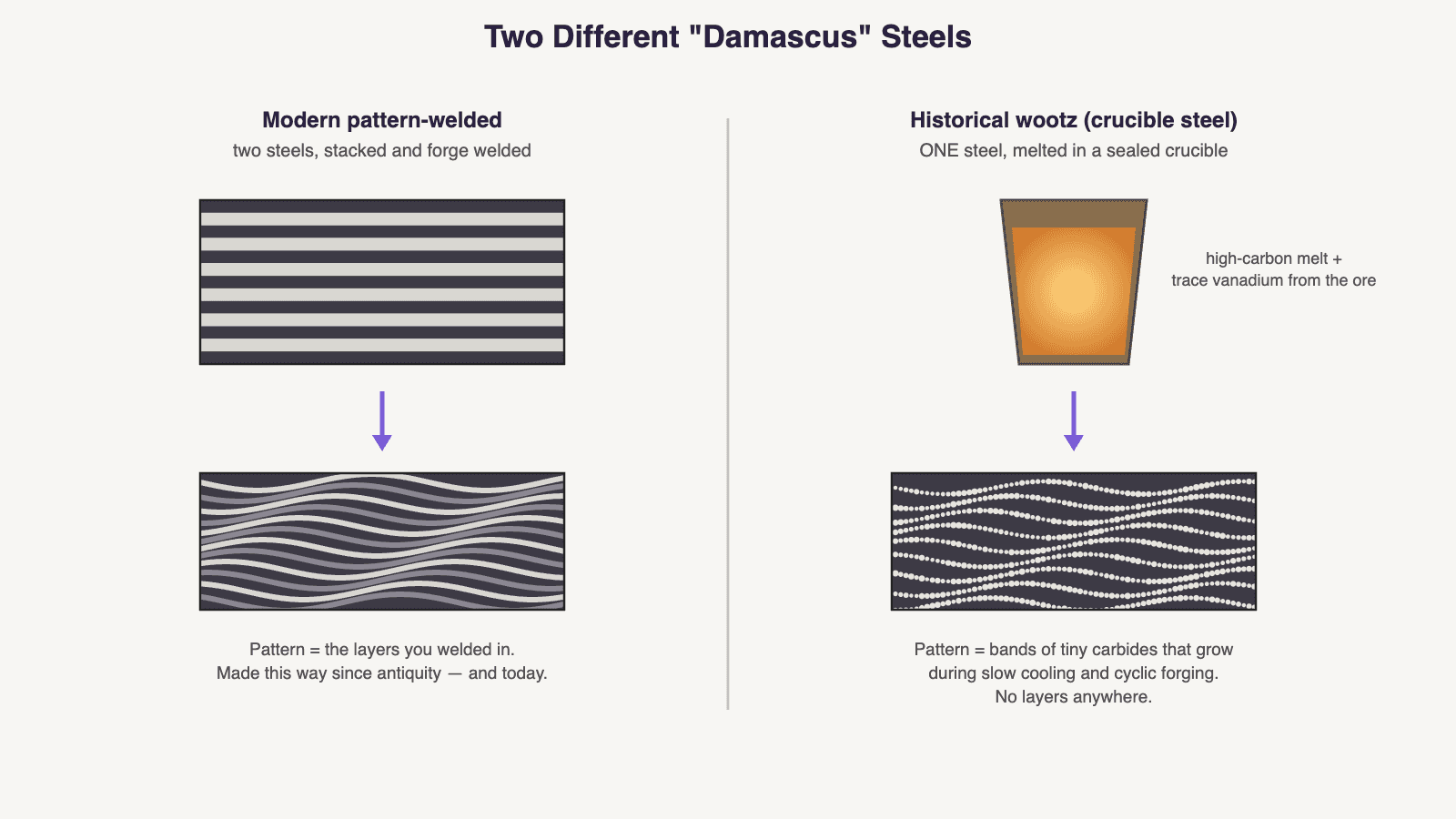
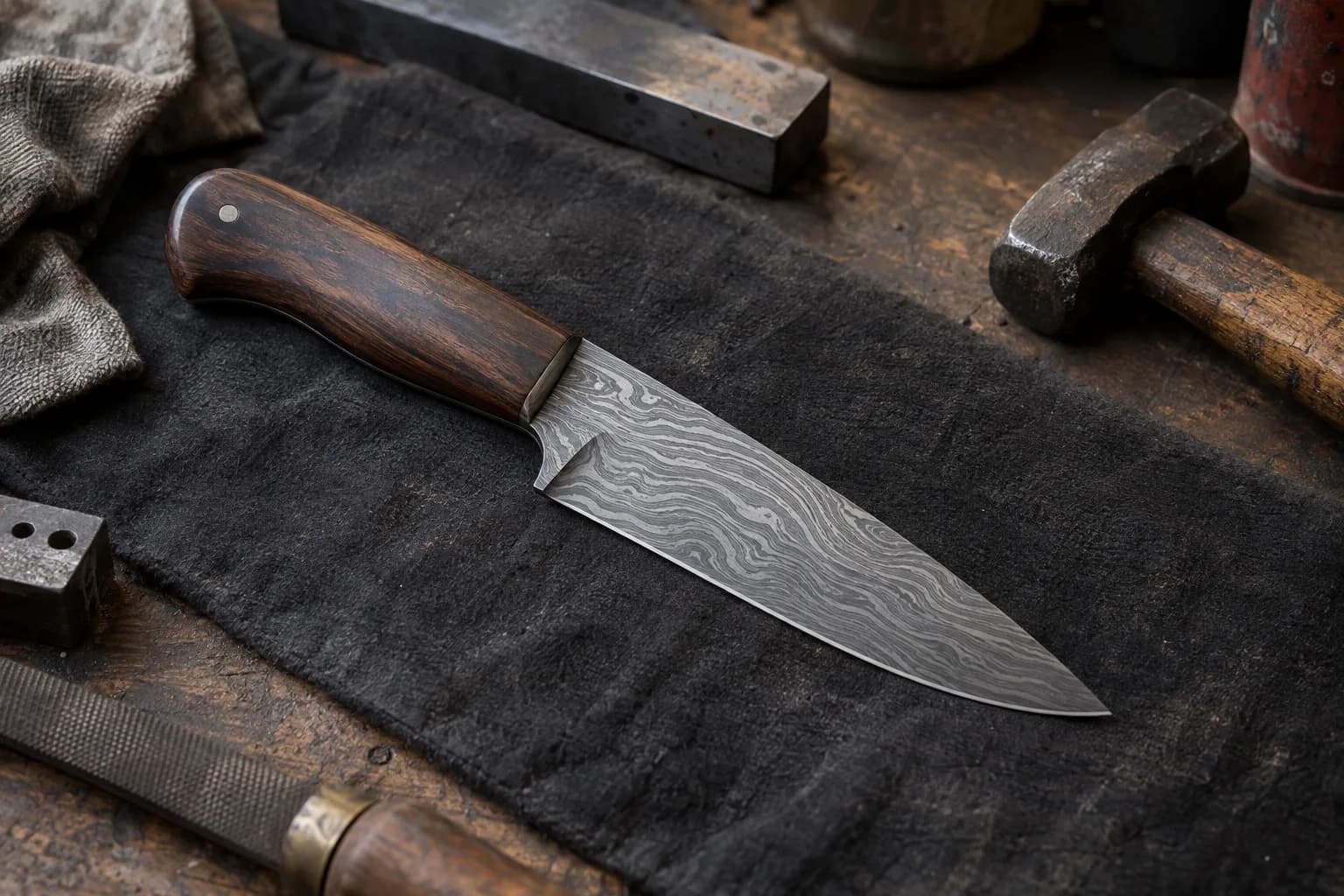
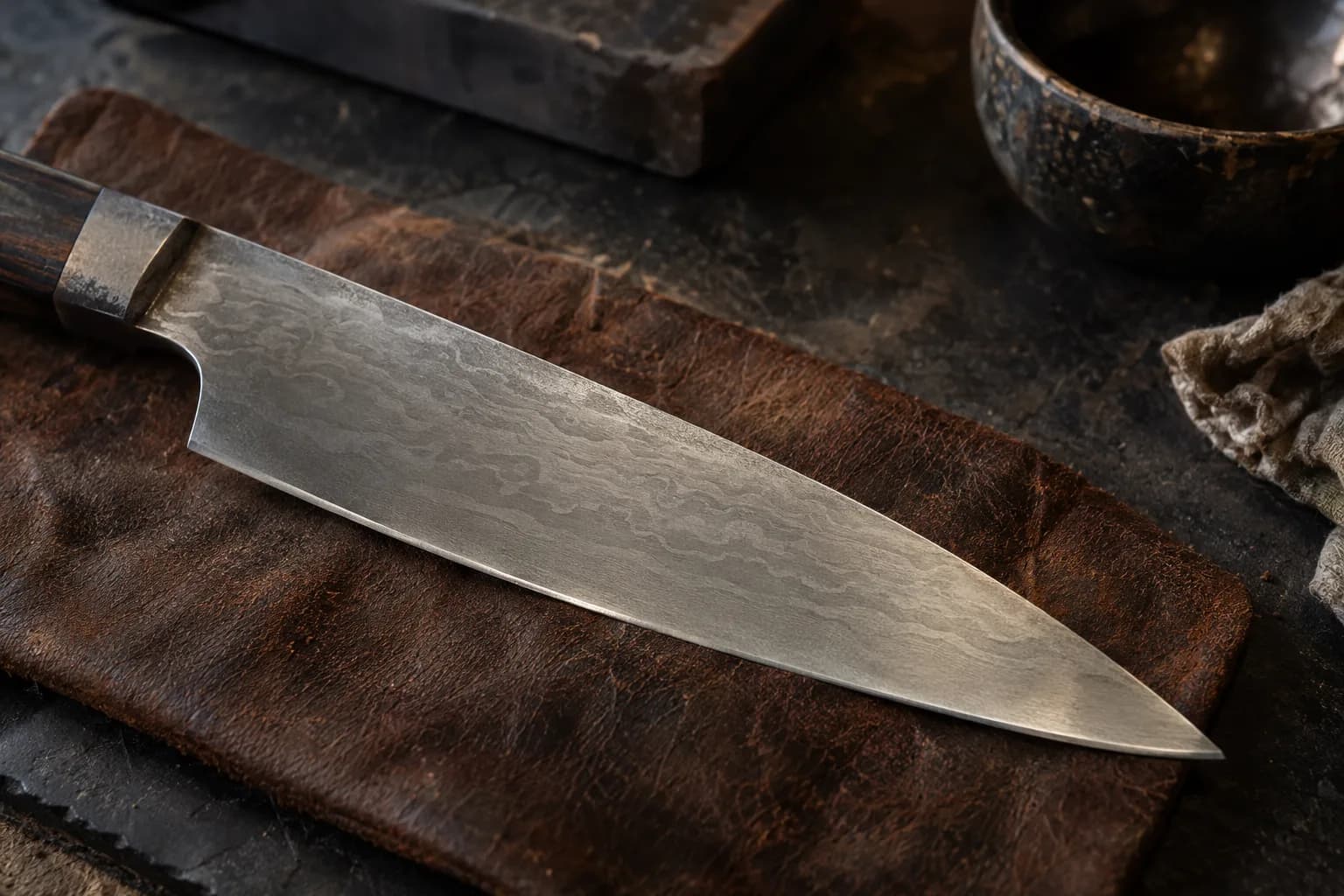
Everything in this section of ForgeBrain — layered billets, ladders, twists — is pattern welding: two steels forge welded so their layers show as a pattern. Smiths have done it for well over a thousand years (Viking-era swords, Japanese work, Indonesian keris), and modern makers do it better than anyone in history thanks to clean modern steels like 1084 and 15N20. When a knife today says “damascus,” this is what it means. Real steel, real technique, no lost secrets.
The famed blades of Damascus-the-city were forged from wootz: crucible steel produced in South India and Sri Lanka starting well over two thousand years ago. The recipe reads almost mundane — iron, carbon sources, sealed clay crucible, melt, cool slowly — but the result was extraordinary: an ultra-high-carbon steel (~1.5%) whose surface showed flowing, watery bands that were not layers. They were bands of microscopic iron-carbide particles, aligned into sheets inside a single homogeneous steel, revealed by grinding and etching. High hardness from the carbon, usable toughness from the banded structure: a genuinely advanced material for its era.
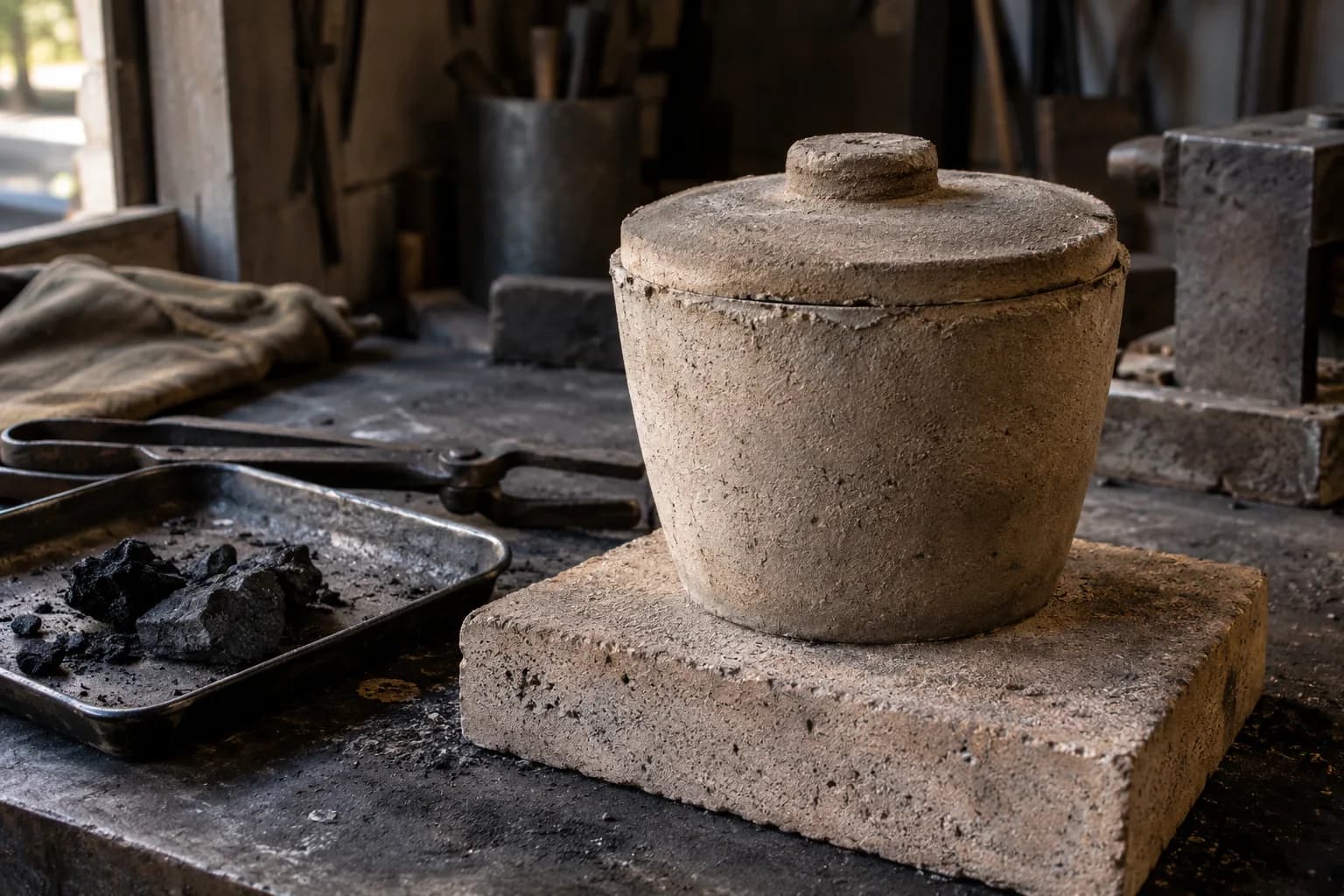
By roughly the late 1700s–1800s, wootz production faded and died — the collapse of the traditional Indian crucible-steel industry under colonial trade restructuring took the working knowledge with it. Europeans spent the 19th century trying and failing to reproduce the watered blades (Faraday himself took a crack at the problem). The pattern wouldn’t come, and “the lost secret of Damascus steel” entered legend.
The modern resolution came from metallurgist John Verhoeven (Iowa State University) working with bladesmith Al Pendray, published in 1998: the banding depends on trace impurities in the original ore — vanadium above all, at levels of mere hundredths of a percent. During the repeated heating-and-cooling cycles of forging, those traces seed the carbides into ordered sheets. Ore from the historic Indian sources carried the right traces; European ores didn’t — so European smiths with correct-looking recipes got plain steel, and when the historic ore sources were exhausted, the “secret” died with them, because nobody knew the secret was in the dirt. Verhoeven and Pendray proved it by making genuine banded wootz from vanadium-bearing melts — after roughly a decade of trying.
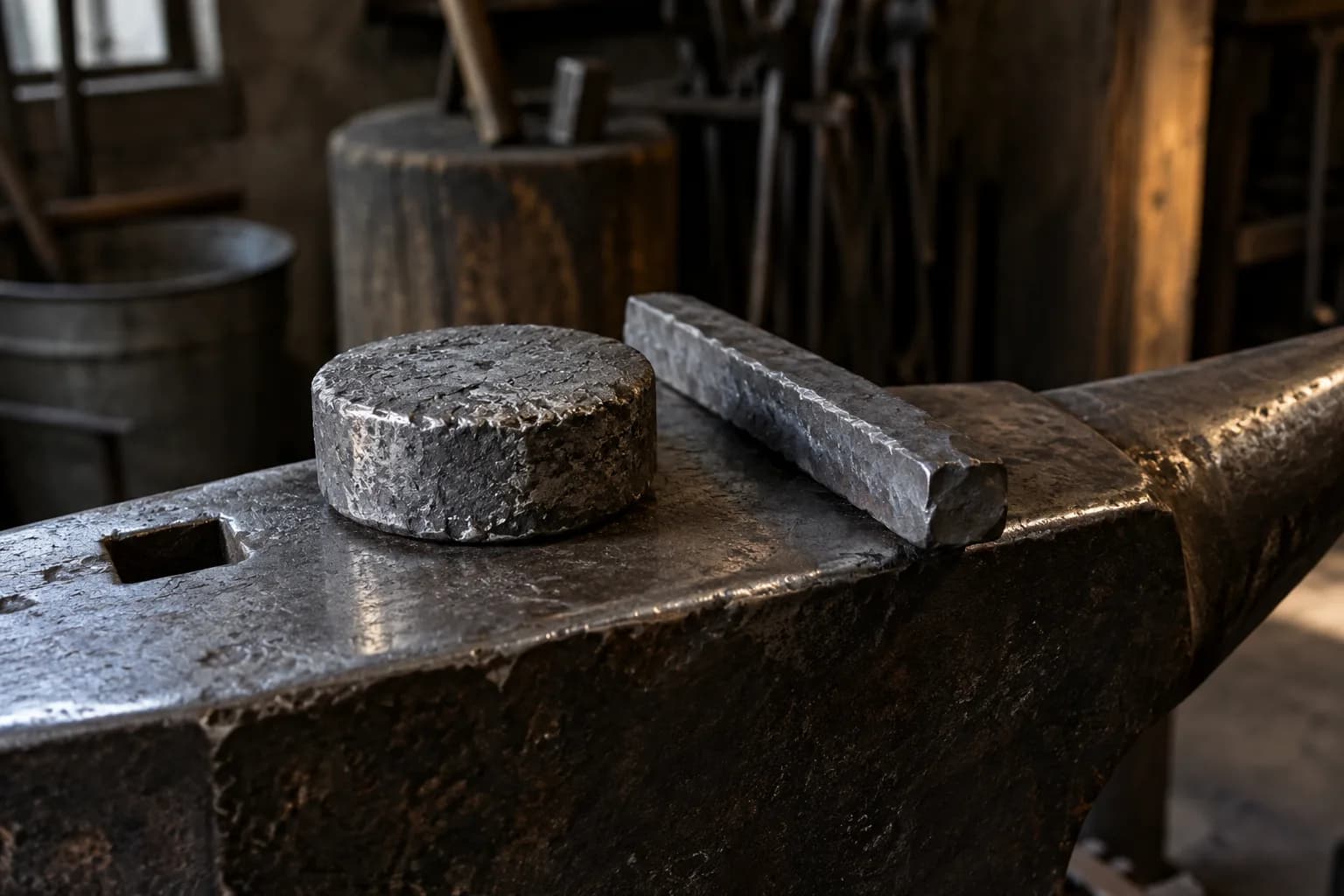
Want the deeper metallurgy of why carbide structure controls a blade’s behavior? Our carbide guide and steel categories guide pick up exactly where the wootz story leaves off — and if the history has you itching to make layered steel yourself, the first billet guide is the modern door in.
Keep reading
Three more from the same bench.
Modern “damascus” is pattern-welded steel: two different steels stacked, forge welded into one solid billet, and manipulated so that grinding and etching…
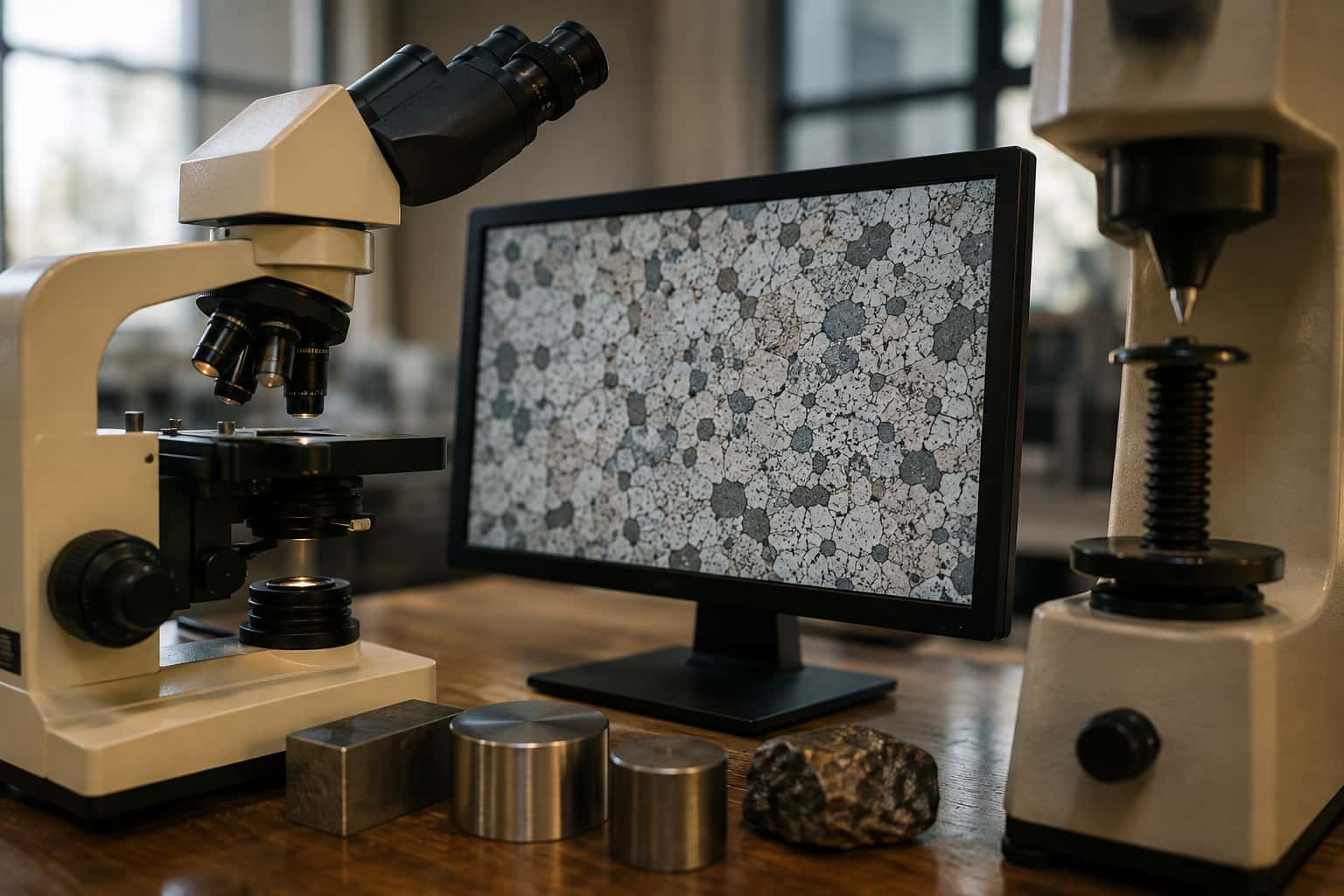
Two steels with similar hardness numbers can feel completely different under a sharpening stone, one glides along smoothly, another feels like it’s…
“Carbon steel,” “stainless steel,” “tool steel,” and “powder metallurgy steel” get used as if they’re four completely separate categories, but they…
Same bench
I machine the parts, hand-assemble, track and test Torus grinders in Sterling, Illinois. Most orders ship in seven to ten business days from time of order.
Current dual-axis platform with a fiber-laser-cut 6061 chassis and single-knob tracking.
Current dual-axis platform with a steel chassis, more mass and less vibration.
Prior-design aluminum chassis, 90-degree tilt and 1.5-inch tooling arms.
One-man shop
I answer my own email. Tell me the steel, the machine and what it is doing, and I will tell you what I would try next.