

Kitchen Knife Geometry: Why Thin Behind the Edge Wins Dinner
Kitchen performance is geometry: 0.010-0.015 inch behind the edge (the ruling number), ~2-2.5mm spine with distal taper, tall full-flat grind, 45-50mm+ heel height for knuckle clearance, and a flat-spot-plus-gentle-belly profile. Fine-grained steels (AEB-L, MagnaCut, 52100) at 12-15 degrees per side finish the job - sharpness gets the first millimeter of the carrot, thinness gets the rest.
Kitchen knives are where blade geometry stops being theory and starts being dinner. A camp knife forgives a thick grind; a chef’s knife wedges apart a carrot and gets left in the drawer. The difference isn’t the steel and it isn’t even the sharpening — it’s geometry, and it’s why kitchen knives are simultaneously the easiest knives to grind (flat! thin! no guard!) and the hardest to grind well.
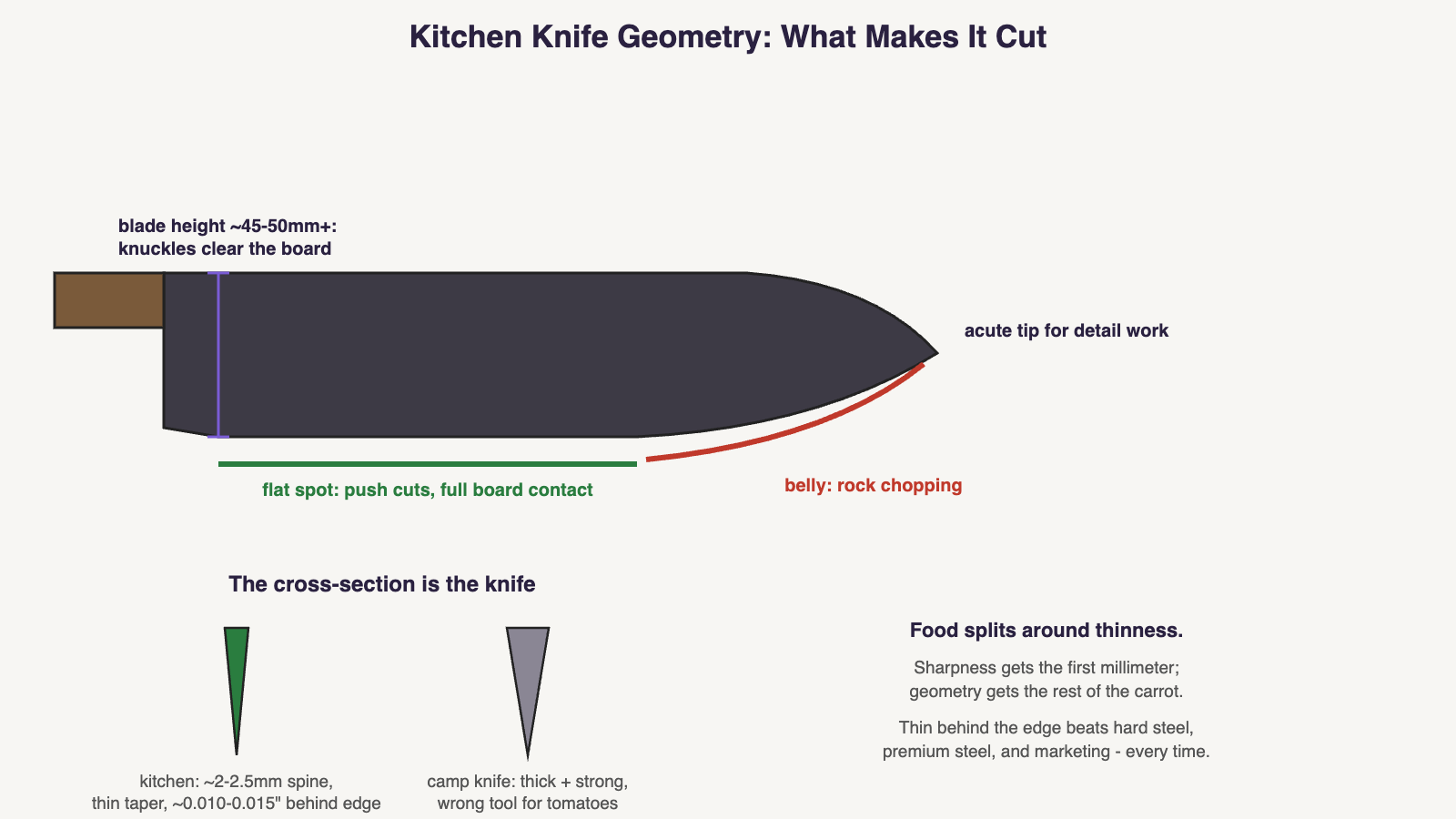
The Law: Food Splits Around Thinness
Sharpness gets the edge into the carrot; the cross-section decides whether the rest follows cleanly or cracks apart in a wedge. The number that rules kitchen performance is thickness behind the edge (BTE): measure a millimeter or two up from the apex. The maker-consensus target for a chef’s knife is 0.010–0.015″ before sharpening (fine slicers and Euro-style chef’s knives push toward 0.008–0.010″). A blade at 0.020″+ BTE will feel “fat” on food no matter how scary-sharp the apex is. This is the whole game — everything else on this page supports it.
- Spine: ~2–2.5mm stock for a chef’s knife (compare our thickness & distal taper guide) — kitchen knives are the strongest argument for thin stock and real distal taper.
- Full flat or high flat grind, tall as the blade allows — tall thin wedges shed food; short thick saber grinds steer it (see grind types). A gentle convex works too; hollow grinds are wrong here.
- The quench matters: blades this thin potato-chip in liquid — which is exactly what plate quenching exists for.
Profile: Where the Work Happens
- Blade height ≥ ~45–50mm at the heel — your knuckles need clearance over the cutting board, and tall blades steer straighter through big produce. The classic beginner mistake is a beautiful 38mm-tall “chef knife” that raps knuckles on every stroke.
- Flat spot vs. belly is a personality choice: a long flat rear section serves push-cutters and tap choppers (the Japanese-leaning style); a continuous curve serves rock-choppers (the German habit). Split the difference like most modern makers: flat back two-thirds, gentle sweep to the tip.
- The tip stays low and acute — near or below the mid-height of the blade for board work, fine for scoring and onions.
- Ease everything hands touch: round the spine and the choil area to a polish. Hours of prep grip the blade, not just the handle — sharp corners on the spine are the most common flaw in maker kitchen knives.
Steel and Edge, Kitchen Edition
The kitchen favors fine-grained steels that take keen, thin edges: AEB-L is the maker darling for exactly this (we grind it enough to have a dedicated AEB-L kitchen guide), with MagnaCut, 154CM, and — for patina-friendly carbon — 52100 and 1084 (see forced patinas) all excellent. Edge angles run fine: 12–15° per side (sharpening guide), supported by that thin BTE. Carbide-coarse steels like D2 fight the whole concept — the carbide guide explains why.
A Maker’s Shortcut
Before designing from scratch, trace a knife the cook in your life already loves — commercial kitchen knives embody a century of geometry consensus, and your first from-scratch template teaches more with that head start. Then thin it more than feels safe. The universal review of a first maker kitchen knife is “great, but a little thick” — spend that lesson here instead.
Sources
- Kitchen Knife Forums — blade geometry and thickness
- KnifeDogs — final thickness for chef’s knives
- Topham Knife Co — Advanced Chef Knife Grinds
Common Mistakes
Grinding a ‘chef knife’ too short for knuckle clearance. Leaving 0.020 inch+ behind the edge and blaming the sharpening. Thick saber grinds that wedge food. Sharp square spines on a blade hands pinch-grip all day. Coarse-carbide steels for fine edges. Liquid-quenching a 2mm blade instead of plates.