
Advanced Damascus: W’s, Multi-Bar Composites & Turkish Twist
W's damascus comes from forging a bold-layer billet with its layers standing vertical - drawing buckles them into W folds, multiplied by restacking, with the pattern on the end grain (accordion-cut to bring it to the face). Multi-bar composites weld several patterned bars side by side; turkish twist does it with bars twisted in alternating directions for interlocking herringbone.
Past the ladder, twist, and raindrop lies the territory where damascus becomes composition: patterns built by controlling the layers in three dimensions and assembling bars like an artist assembles a canvas. This guide surveys the three big ones — W’s, multi-bar composites, and the turkish twist — with enough technique to start and honest notes on difficulty. They share one prerequisite: you can already weld a clean billet on demand (start here if not).
W’s and Crushed W’s
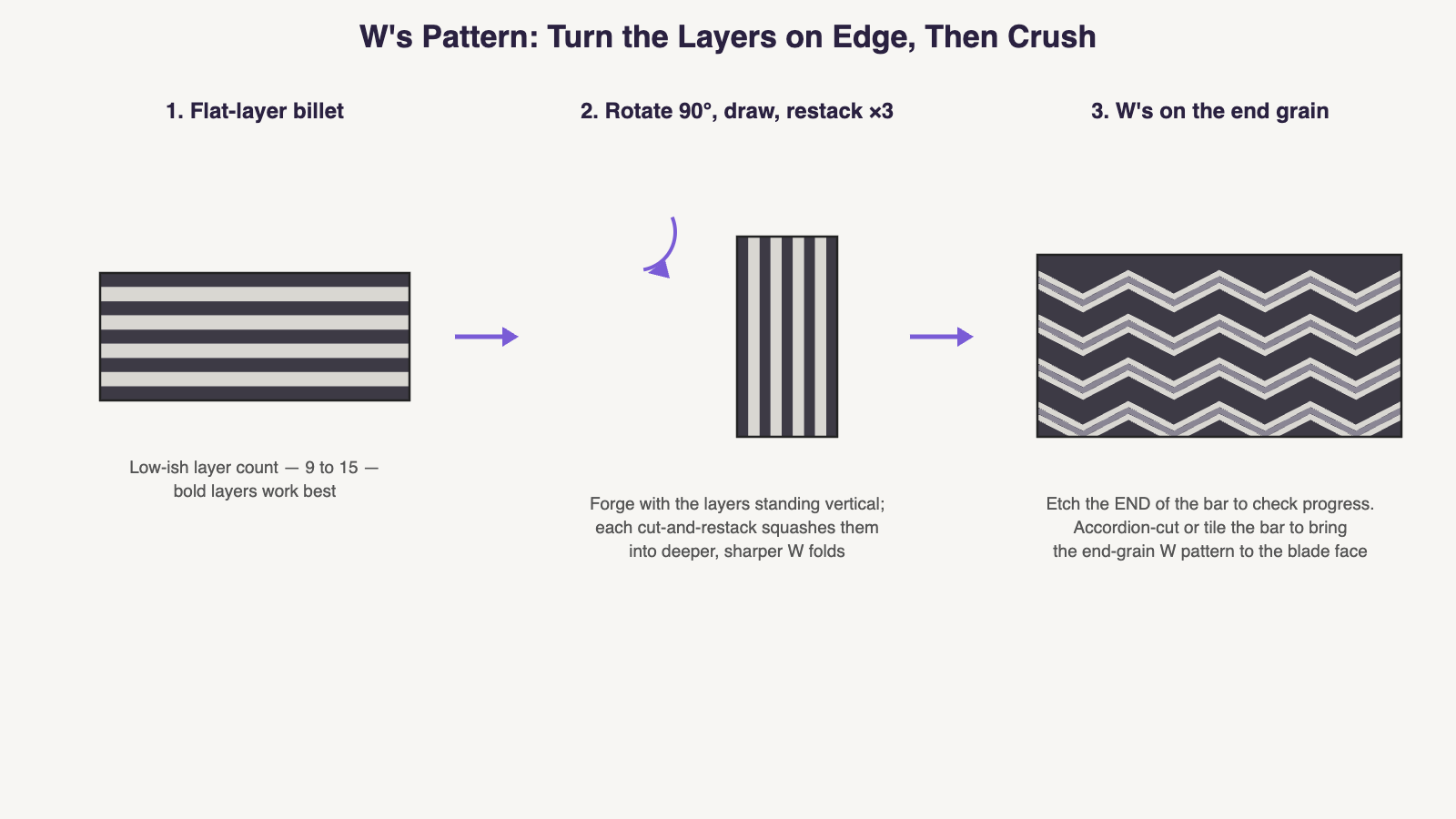
The foundation of most spectacular mosaic damascus. The move that makes it: after welding a bold, low-layer stack (9–15 thick layers), rotate the billet 90° and forge it with the layers standing vertical. Drawing a bar with vertical layers doesn’t keep them straight — it buckles them, and buckled layers are W’s. Cut, restack (keeping layers vertical), and weld again: each cycle multiplies and sharpens the folds. “Crushing” — upsetting the bar or forging it on the bias as a finishing move — squeezes the W’s tighter and more dramatic.
The catch: the pattern lives on the end grain of the bar, not the flats. Etch the bar’s end to check progress, and to put the pattern on a blade face you either tile end-grain slices or accordion-cut the bar — deep alternating cuts that let it unfold like its namesake so the end grain becomes the new face. Accordioning is its own skill and where most first W’s projects wobble; budget practice material.
Multi-Bar Composites
Instead of one billet making one blade, forge several patterned bars and weld them side by side — a twist bar at the spine, a fine straight-laminate bar at the edge, maybe an “edge bar” of plain steel for function. Lay out the bars, grind mating faces dead flat, seal or flux, and weld the assembly as one unit; the blade then wears visibly different zones like panels in a painting. Historically this is how pattern-welded swords were built (core bars + edge steel), so you’re in thousand-year-old company. Precision matters more than heat here: bar faces that aren’t flat and clean give you a visible glue-line — or an open seam — right down the middle of a showpiece.
Turkish Twist
The aristocrat of multi-bar work: several bars (commonly three or four), each twisted tightly — alternating direction bar to bar — then welded side by side and forged into the blade. Opposing twist directions meeting along the seams create interlocking herringbones and rolling stars that seem to move in the light. Everything from the twist guide applies, multiplied: rotation counts must match bar to bar (count them), twist tightness sets pattern scale, and the final side-by-side weld is a multi-bar composite weld with all the flatness discipline above. Expect to make it twice before you make it well — and expect the second one to stop conversations.
Where to Go from Here
All three reward the same fundamentals: dead-solid welds, patient even heats, and layout thinking before the forge is lit — sketch the target pattern and work backward to the bar construction. The canister method reaches some of the same mosaic territory by a completely different road, and for the deepest end of the pool, the mosaic work of smiths like Robert Eggerling shows where these building blocks lead. Etch everything as you go (etching guide) — end-grain test etches are the only honest progress report W’s work gives you.
Sources
- American Bladesmith Society forum — W-Pattern
- BLADE Magazine — How to Create Damascus Patterns
- BladeForums — crushed W’s technique
- Robert Eggerling — mosaic damascus (where the road leads)
Common Mistakes
Starting W’s with fine layers instead of bold ones. Forgetting the pattern is on the END grain and etching the flats to check progress. Accordion cuts with no practice material budgeted. Multi-bar welds on faces that aren’t dead flat. Turkish twist bars with mismatched rotation counts.