2×72 Belt Grinder Brands Compared: The Honest Field Guide
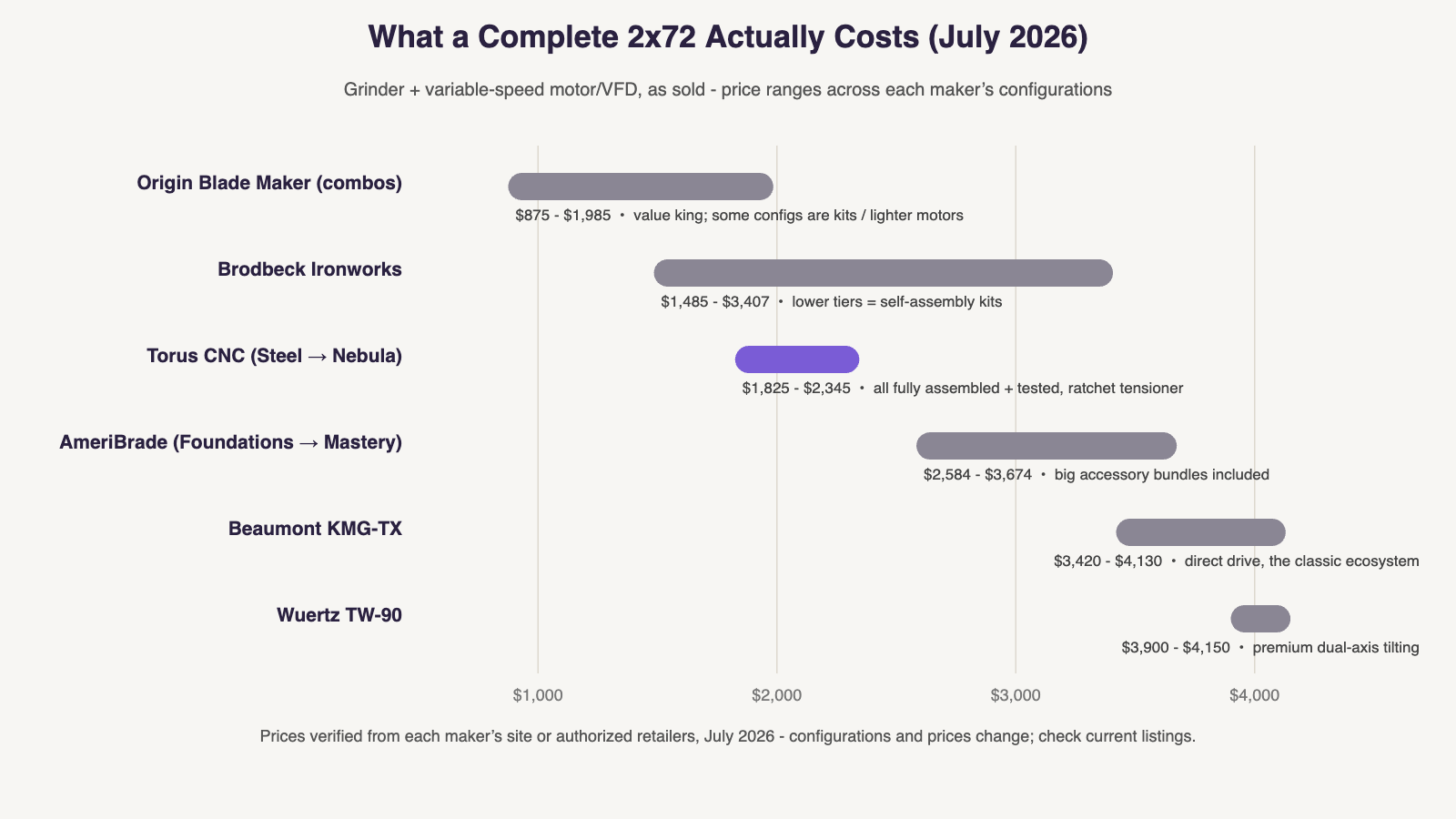
The American 2x72 field by complete-setup price (grinder + variable-speed motor, July 2026): Origin Blade Maker $875-1,985 (value king, some self-setup), Brodbeck $1,485-3,407 (kits at lower tiers), Torus CNC $1,825-2,345 (fully assembled, ratchet tensioner, 90-degree tilt), AmeriBrade $2,584-3,674 (accessory bundles), Beaumont KMG-TX $3,420-4,130 (direct drive, the classic), Wuertz TW-90 $3,900-4,150 (premium). Disclosure: this is Torus CNC's site - every competitor spec verified from their own listings.
Full disclosure, before anything else: this is Torus CNC’s site — we build three of the grinders compared below. Here’s how we’ve kept this honest: every competitor spec and price was verified from the maker’s own site or authorized retailers in July 2026 (linked in Sources), we say plainly where a competitor is the better choice, and we’d rather you buy the right grinder than our grinder. The knifemaking community is small and long-memoried; fudging a comparison would cost us more than it could ever earn.
With that on the table: here’s the American 2×72 field as it actually stands.
The Field, Brand by Brand
Origin Blade Maker (Revolution) — the value king
OBM has built a huge following on one promise: the most grinder per dollar in the game. Welded steel chassis (no bolted joints to loosen), gas-strut belt tensioning, an enormous accessory catalog, and complete motor/VFD combo packages listed from roughly $875 to $1,985 depending on motor size — with their famous pitch that a working setup lands under $700 if you pair the chassis with a budget compressor-duty motor. The Dominator variant adds tilting. Honest tradeoffs: the budget path means sourcing/wiring your own motor, gas-strut tension is smooth but doesn’t hold position the way a ratchet does under belt changes, and at these prices you’re comparing against machines that cost more for reasons you may or may not need. Choose OBM if budget is the constraint and you’re comfortable doing some of your own setup — it’s the best cheap entry in the field, full stop.
Brodbeck Ironworks — the modular ladder
Brodbeck sells a path more than a product: packages from $1,485 to $3,407 where the lower tiers arrive as self-assembly kits and only the top tier ships pre-assembled (with a lead time). Well-liked machines, flexible configurations, and the kit route saves real money if you enjoy wrenching. Choose Brodbeck if you want to climb from kit to full machine within one ecosystem and assembly is a feature, not a chore.
Torus CNC (ours) — ratchet tension, dual-axis tracking, open 1.5″ ecosystem
Our lineup runs from the prior-generation Torus 2×72 Steel ($975, closeout while stock lasts) and The Torus-2×72 Classic (aluminum, $1,295 — the proven original, still in production) to the current flagships — the 6061-aluminum Nova ($1,395) and 3/8″-steel Nebula ($1,495) — plus an $850 motor/VFD combo, putting a complete setup at $1,825–2,345, every machine fully assembled and tested with 90° tilt on Nova/Nebula.
Three features define every Torus machine, and they’re the three we’d tell you to check on any grinder:
- Stainless ratchet belt tensioner. One-handed belt changes that lock positively in place — no gas-strut drift, no spring bounce under load. When a working session means swapping between grinding, finishing, and sharpening belts dozens of times, the tensioner is the part of the grinder you touch most.
- Dual-axis tracking. A machined billet-aluminum mechanism (tracking handle included) that adjusts on two axes instead of one, so the belt runs true and stays true — across attachment changes, belt changes, and speed changes — instead of needing a re-chase every swap (the failure mode behind half the belt-tracking complaints on the forums).
- Standard 1.5″ square tooling arm — the open ecosystem. The 1.5″ arm is the de facto industry standard, which means the broader market’s attachments — small wheel setups, contact wheels, rotary platens, third-party specialty tooling — slide right in. You’re never locked to one maker’s catalog (contrast: proprietary arm sizes elsewhere in this list), and your attachment collection outlives any single machine.
Our honest pitch: in this field, fully-assembled + ratchet tensioning + dual-axis tracking + tilt otherwise starts around $2,600 — we exist to put that feature set in the under-$2,500 bracket, on standard arms — and buyers back the execution: 5.0-star averages on both Google (16 reviews) and Etsy (33 reviews) as of July 2026, with “every piece is machined so well” and “even the packaging is professionally done” among the recurring themes. Our honest tradeoffs: we’re the younger company on this list, our in-house accessory catalog is smaller than OBM’s or Beaumont’s (though the standard arms mean the whole industry’s attachments are effectively our catalog too), and our motor combo tops out at configurations a production shop might outgrow.
AmeriBrade (Fastback) — the bundle play
AmeriBrade sells the Fastback frame in curated packages — Foundations from $2,584 and Mastery from $3,674 with variable-speed motor, pre-wired controller, and a genuinely generous pile of accessories (packages include nine small-wheel sizes with storage racks). Reverse tracking, tilting platen assembly, assembled and tested, 2-year warranty on motors/controllers/wheels/bearings. Honest tradeoff: the Fastback uses a 2″ square tooling arm rather than the de-facto-standard 1.5″ — the machine and its ecosystem are excellent, but attachments come from AmeriBrade. Choose AmeriBrade if you want one box that contains your next two years of accessory needs and the warranty matters to you.
Beaumont Metal Works (KMG / KMG-TX) — the institution
The KMG is the machine much of the modern 2×72 world descends from, and Beaumont’s attachment ecosystem and multi-decade track record are unmatched. The current KMG-TX runs $3,420–4,130 complete — direct-drive motor and VFD included, ratcheting tension, lever-release tilt from vertical to horizontal, Axis Neutral Tracking, pre-wired, made to order in Ohio. Honest tradeoff: you’re paying the institution premium, and made-to-order means waiting. Choose Beaumont if you want the reference machine with the deepest ecosystem and buy-once-cry-once is your philosophy.
Wuertz Machine Works (TW-90) — the pro’s darling
The TW-90 ($3,900–4,150 assembled with motor/VFD) is the refinement play: dual-axis tilting, beautiful machining, and a devoted following among full-time makers. Choose the TW-90 if the grinder is your daily professional tool and the premium amortizes over thousands of blades.
Other names you’ll hear with good reputations — Northridge Tool, Pheer, Reeder Products — we haven’t verified current specs and pricing for this guide, so we’ve left them out of the table rather than guess.
How to Actually Choose
- Hard budget under ~$1,500 all-in: OBM with a self-sourced motor, or a Brodbeck kit. Nothing else plays there.
- $1,800–2,500, want it assembled and complete: this is our neighborhood — a Nova or Nebula with the motor combo — and we think the ratchet tensioner, dual-axis tracking, 90° tilt, and standard 1.5″ arms make it the bracket’s best value. (Told you we’d be honest about where we’re biased.)
- $2,600–3,700, accessories-first: AmeriBrade’s packages are hard to beat as a one-decision purchase.
- $3,400+, buy-once: KMG-TX or TW-90 — ecosystem vs. refinement; you won’t regret either.
Whatever the brand: prioritize variable speed (non-negotiable for sharpening and handle work), check what a complete running machine costs (chassis-only prices hide motors), and see our full 2×72 buyer’s guide for the spec-by-spec breakdown and what the whole craft costs.
Sources (verified July 2026)
- Origin Blade Maker — product listings and combo pricing
- Brodbeck Ironworks — package configurations
- Beaumont Metal Works — KMG-TX and Soul Ceramics retail listing
- AmeriBrade — Fastback and package retail listings
- Wuertz Machine Works — TW-90
Common Mistakes
Comparing chassis-only prices against complete machines. Buying single-speed to save money (variable speed is the feature you’ll use every session). Ignoring tooling-arm size when you plan on third-party attachments. Trusting any comparison – including this one – without checking the makers’ current listings.
Related Pages
- Torus vs. Origin Blade Maker (Revolution 2×72): An Honest Comparison
- Torus vs. Beaumont KMG-TX: An Honest Comparison
- Torus vs. AmeriBrade Fastback: An Honest Comparison
- How to Choose a 2×72 Belt Grinder: Complete Buyer’s Guide
- Torus vs. Wuertz TW-90: An Honest Comparison
- Torus vs. Brodbeck Ironworks: An Honest Comparison