
BELT GRINDERS
A belt that won’t stay centered ruins more than your patience. It rounds your platen edge, chews your work rest, and throws off every bevel you grind. Tracking is the foundation. Get it right and the machine disappears. Get it wrong and you fight the tool all day. Here is how to dial it in and keep it there.
KEY TAKEAWAYS
- Tension first, tracking second. A loose belt wanders no matter how you set the wheel.
- Every wheel must sit on the same centerline and run parallel.
- Adjust in small moves. Nudge, spin by hand, recheck.
- A belt that tracks off the platen but walks on it means the platen face is not flat or square.
- A worn or cheap belt can wander on its own. Swap it before you chase ghosts.
START WITH TENSION
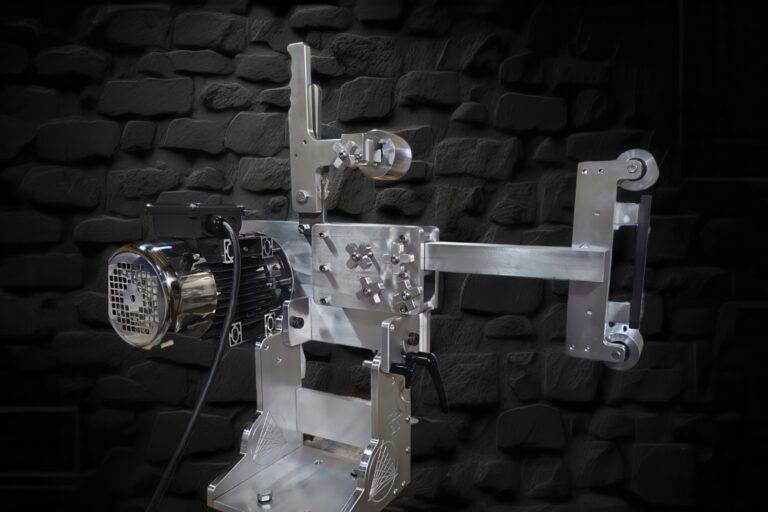
Most tracking problems are tension problems in disguise. A belt run too loose walks toward whatever side you push on. Crank tension up first. Then set your tracking. On a good machine, tension and tracking are separate systems, so you can dial one without disturbing the other. That is the whole point of a machined tracking axis and a proper ratchet tensioner.
GET YOUR WHEELS ON ONE LINE
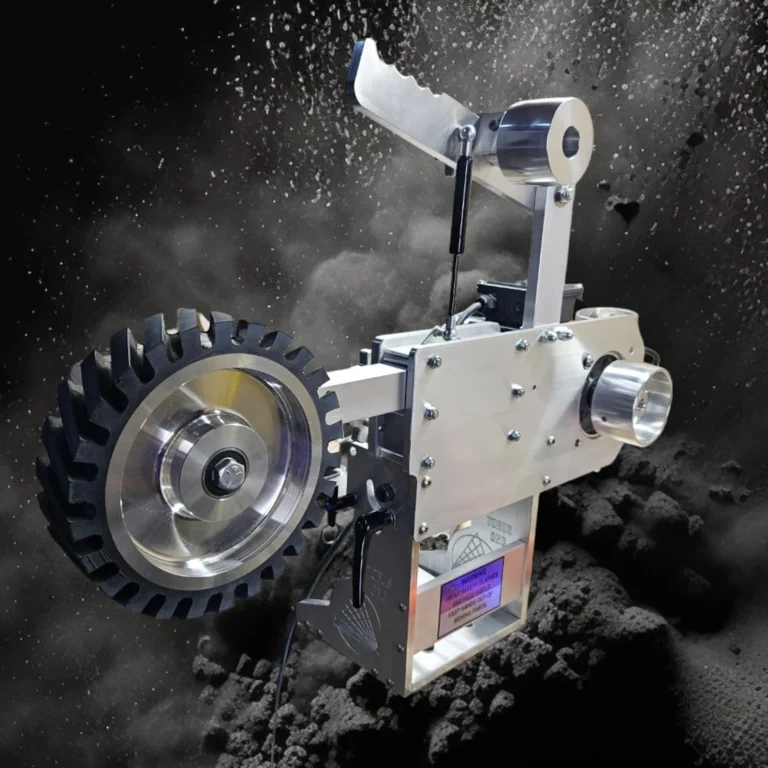
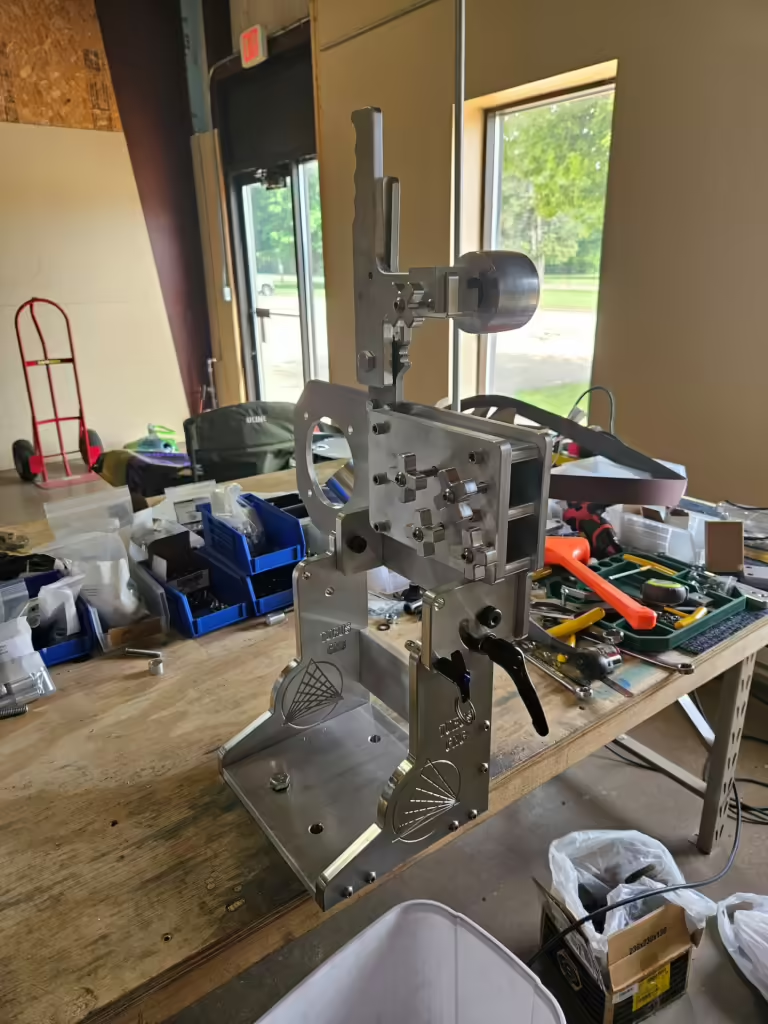
Belts track true when every wheel shares the same centerline and every axle runs parallel. If your tracking wheel or contact wheel sits even slightly out of square with the drive wheel, the belt chases a wobbling circle like a spinning top winding down. It never settles. Sight down the belt path. The belt should ride centered on the drive, tracking, and contact wheels at once. This is where machine quality shows. A grinder built from machined billet holds its geometry cold. That is why the NOVA and NEBULA use a machined dual-axis tracking system instead of a bent bracket.
ADJUST SMALL, CHECK OFTEN
Do not chase tracking with big turns of the knob. Make a small change, spin the belt by hand a full rotation, and watch where it settles. Then power it on briefly. Repeat. Two or three tiny nudges beats one wild swing every time. Rushing this step is how makers spend an hour convinced the machine is broken.
WHEN THE PLATEN IS THE PROBLEM
Here is a common trap. The belt tracks perfectly off the platen, then walks the moment it touches the platen face. That is not a tracking-wheel issue. Your platen is either not square to the belt path or its face is not flat. Check it with a straightedge. A dished or tilted platen fights your tracking every pass, and no amount of knob-turning fixes it. Repeatable grinding starts with equipment that holds true, and a flat platen is non-negotiable.
DO NOT RULE OUT THE BELT
Sometimes the machine is fine and the belt is junk. A worn belt, a bad splice, or a cheap import can wander on its own. Before you tear down your setup, throw on a fresh quality belt and watch. If the wander disappears, you found it. Good belts are cheap insurance against wasted shop time.
SET IT AND FORGET IT
Once your geometry is right, tracking becomes a five-second check, not a daily battle. That consistency is what lets you grind clean bevels back to back without babysitting the belt. A machine that tracks true is a machine that gets out of your way.
If your current grinder wanders no matter what you do, the problem may be built in. The aluminum Classic still ships as the rock-steady original, and the fully assembled Steel is on closeout at $975 while stock lasts. Both track dead straight out of the box.
Ready to stop fighting your belt? See the full lineup over at the shop.